

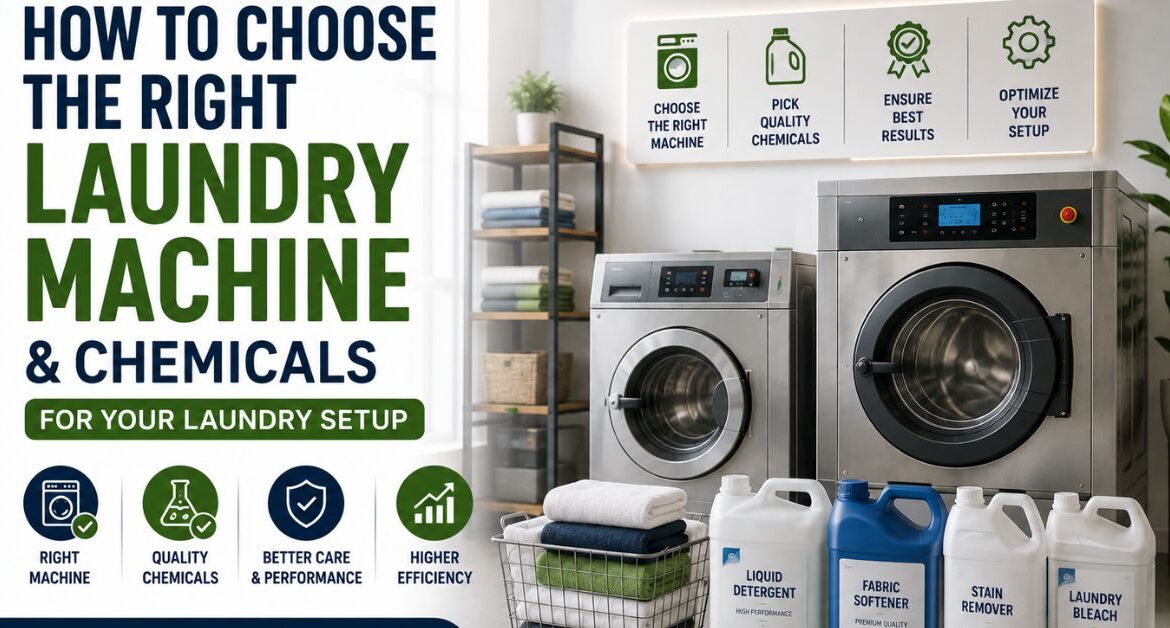
When opening a laundry business it seems easy, buy a machine, fill it with soap and wash clothes. The equipment and chemicals you choose during month 1 of your laundry business can affect your profitability, productivity and customer happiness for years to come. Selecting the incorrect size machine or improper chemicals will affect more than your wash quality. It will affect your operating costs, garment damage and time it takes to earn your reputation.
We will go over some practical concerns when looking to buy laundry machines or chemicals. Rather than leaving it up to chance or what a sales person wants you to buy. This guide is for current and future laundry business owners operating in India.
Why Equipment and Chemical Selection Matters More Than People Realize
Many first-time laundry business owners assume that any commercial washing machine will do the job, and any detergent labeled “industrial” is good enough. This assumption often leads to avoidable problems down the line, machines that are either too small for actual demand or too large for the available space, chemicals that damage delicate fabrics, or water and detergent wastage that quietly eats into margins every single day.
Unlike a one-time purchase decision, laundry equipment and chemical selection is an ongoing operational choice. It affects daily electricity and water bills, the frequency of machine servicing, the lifespan of your equipment, and most importantly whether customers trust you with their clothes again after the first wash.
Understanding Your Laundry Volume Before Choosing a Machine
The very first thing to consider when buying any laundry equipment should be your expected daily or weekly volume. Many decisions you make after this will be dictated by this one piece of information.
The expected laundry volume for a small neighborhood laundromat filled with residential customers will be much less than a commercial business that processes contracts with local hotels, hostels, and hospitals. Having even a ballpark idea of this will save you from the two biggest mistakes people make: Buying too little capacity and creating a bottleneck when customer demand is highest, and buying too much capacity that will never be used but still takes up space and needs maintenance.
Key Factors to Consider When Choosing a Laundry Machine
Selecting the right washing and drying equipment involves evaluating several practical factors together, rather than focusing on price alone.
- Load capacity — Machines are typically categorized by kilogram capacity per cycle. Estimating your average daily volume helps determine whether a 15 kg, 25 kg, or larger capacity machine suits your operation, avoiding both overcrowding and underutilization.
- Machine type — Front-load machines are generally more water and energy-efficient and tend to be gentler on fabrics compared to top-load machines, though they usually come at a higher upfront cost.
- Water and energy efficiency ratings — Since water and electricity are ongoing operational costs, machines with better efficiency ratings can significantly reduce monthly utility expenses over time.
- Programmable wash cycles — Machines offering multiple pre-set or customizable wash cycles allow better handling of different fabric types, from delicate garments to heavily soiled workwear.
- Build quality and after-sales service — Commercial machines undergo far more daily wear than home appliances, so checking for available service support, spare parts availability, and warranty terms in your city is essential before purchase.
- Space and installation requirements — Ventilation, drainage, electrical load capacity, and floor space all need to be assessed beforehand, since retrofitting a space after installation is often costly and disruptive.
- Noise and vibration levels — Particularly relevant for setups located near residential areas or within commercial complexes with shared walls.
New vs. Refurbished Machines: What to Consider
Do I buy new machines or refurbished commercial equipment? This is a decision many startup laundry owners wrestle with. Purchasing refurbished equipment can help save some money on your initial investment. New machines typically offer longer life expectancies, are more energy efficient, and come with full warranties. Refurbished machines can cut your cost of investment way down if you’re just starting out, and can be a good way to go if you are planning to test the waters in a new town with your laundromat (as long as you purchase from a trusted source that offers some type of service warranty). At the end of the day it comes down to how much money you have to spend, how much volume you think you’ll get, and how much risk you’re willing to take on.
Understanding Laundry Chemicals: Why “Any Detergent” Doesn’t Work
Chemical selection is just as critical as machine selection, yet it often receives far less attention from new laundry business owners. Using the wrong chemical combination can lead to fabric damage, poor stain removal, unpleasant residual odors, or even customer complaints about skin irritation from chemical residue.
Commercial laundry operations typically require more than a single all-purpose detergent. A properly equipped laundry setup usually relies on a combination of specialized chemicals designed for different stages of the washing process and different fabric requirements.
Essential Categories of Laundry Chemicals for a Professional Setup
Building a reliable laundry chemical inventory generally involves stocking products across several functional categories rather than relying on one multipurpose product for everything.
- Pre-wash stain removers — Used to treat specific stains such as oil, ink, or food residue before the main wash cycle, improving overall cleaning effectiveness
- Primary detergents — Formulated for general fabric cleaning, often available in different variants for cotton, synthetic, or mixed-fabric loads
- Fabric softeners — Used to maintain fabric texture and reduce stiffness, particularly important for garments and linens handled repeatedly
- Bleaching agents — Applied selectively for whites or heavily soiled items, requiring careful dosage control to avoid fabric damage
- Sour or neutralizing agents — Used toward the end of the wash cycle to balance pH levels and prevent chemical residue from remaining on fabric
- Starch and finishing solutions — Common in setups offering ironing or pressing services, used to achieve crisp finishing on shirts and formal wear
- Odor-neutralizing treatments — Increasingly relevant given rising customer expectations around hygiene, particularly for gym wear, towels, and footwear-related laundry services
- Reliable options such as LaundroMentor Chemicals are among the formulations available in the market designed to address these varied requirements for commercial-scale operations
Maintaining a well-rounded chemical inventory across these categories, rather than depending on a single generic product, tends to produce more consistent wash quality and fewer customer complaints related to fabric damage or residual odor.
How to Evaluate Chemical Quality Before Bulk Purchasing
Since chemicals represent a recurring operational cost, it’s worth evaluating a few practical factors before committing to bulk purchases from any supplier.
- Request small trial quantities before placing large bulk orders, to test actual performance on different fabric types
- Check for proper labeling, including dosage instructions and safety data, particularly for bleaching or acidic formulations
- Compare cost-per-wash rather than just per-unit pricing, since concentration levels vary significantly between products
- Assess compatibility with your specific machine type, as certain chemicals may not perform well in all wash cycle configurations
- Look for suppliers offering consistent batch quality, since inconsistent formulations can lead to unpredictable results across different orders
Skipping this evaluation process is a common early mistake that often leads to switching suppliers repeatedly, which can create inconsistent service quality for customers during the transition period.
Balancing Machine and Chemical Choices Together
It’s worth noting that machine and chemical decisions are not entirely independent of each other. Certain chemical formulations perform differently depending on water temperature settings, cycle duration, and machine agitation type. A mismatch between machine settings and chemical dosage can lead to either insufficient cleaning or excessive chemical residue, both of which affect customer satisfaction.
New laundry business owners often benefit from testing a few wash cycles with actual garments before finalizing both machine settings and chemical dosage for regular operations, rather than assuming manufacturer defaults will work perfectly for every fabric type they encounter.
Where Structured Guidance Helps: The Role of LaundroMentor
Decisions about machinery sizing, chemical choices, dosage requirements, cost implications – If you’re running through the laundry startup process for the first time, it can feel like a lot. Which makes a resource like LaundroMentor helpful.
LaundroMentor is not a franchise. We aim to provide insight and direction for startup laundry owners who want to run their own independent business, not open up a location in a branded chain. Our primary mission is to share the systems, operational know-how, and tools used within larger, organized laundry businesses with the small, unorganized store owners who make up the vast majority of laundries across India. Part of this means advising on machinery and chemical profiles which will work for the volume of business and target customer your company plans to serve.
If you’re looking to have some of those decisions made for you out of the gate (at least as far as chemicals are concerned), you can review our chemicals and consumables guide to get an idea of the various categories of products available for commercial laundry operations.
Common Mistakes to Avoid During Setup
Even with good intentions, several recurring mistakes tend to affect new laundry setups during the equipment and chemical selection phase.
- Purchasing machine capacity based on available budget rather than actual projected volume
- Choosing chemicals purely on price without testing fabric compatibility beforehand
- Ignoring water quality in the local area, which can significantly affect both machine longevity and chemical performance
- Overlooking ongoing maintenance costs when comparing machine options
- Failing to train staff on correct chemical dosage, leading to either overuse or underuse
- Not maintaining a buffer stock of essential chemicals, causing service disruptions during supply delays
Avoiding these mistakes during the initial setup phase can save significant time, money, and customer trust during the early, most vulnerable months of running a laundry business.
Final Thoughts
Selecting laundry equipment & chemicals is an ongoing process, not just a “buy once” type of decision. Your choices will have a direct impact on your customer satisfaction levels, operating costs and your ability to retain customers. Carefully assessing your volume, weighing machine options, and developing a versatile chemical kit will be beneficial in the long run rather than rushing to buy what seems cheap at the moment.
If you are looking for a mentorship type of platform which has been designed keeping in mind the needs of an independent laundry owner in India. LaundroMentor is one such platform that helps you take steps towards moving from a loosely-run bootstrap setup to a professional laundry.
Frequently Asked Questions
Is it better to buy new or refurbished laundry machines?
New machines offer longer lifespans and full warranties, while refurbished machines can lower initial investment for early-stage businesses testing demand, provided they're sourced reliably.
What chemicals are essential for a commercial laundry setup?
A well-rounded setup typically includes pre-wash stain removers, primary detergents, fabric softeners, bleaching agents, neutralizing agents, and finishing solutions for different fabric and service needs.
Does water quality affect machine and chemical performance?
Yes, hard or poor-quality water can affect detergent efficiency and contribute to faster machine wear, making water quality an important factor during setup planning.
Does LaundroMentor manufacture laundry machines?
LaundroMentor is not a franchise or manufacturer. It provides structured guidance, systems, and support—including chemical and consumable resources—to help individuals set up and run their own independent laundry businesses.

Aman Sawaran is a leading laundry business consultant who has personally guided over a hundred laundromat owners to success. With years of hands-on experience in the laundry industry, Aman specializes in helping entrepreneurs build and scale profitable laundromats and pick-up & delivery laundry businesses. His step-by-step consulting program covers everything from selecting the ideal distributor and perfect location to securing financing and launching a state-of-the-art laundromat within just 3 to 6 months. Ready to transform your laundry business idea into a thriving venture? Aman can show you how to launch, scale, and maximize your profits with proven strategies and expert guidance.


