

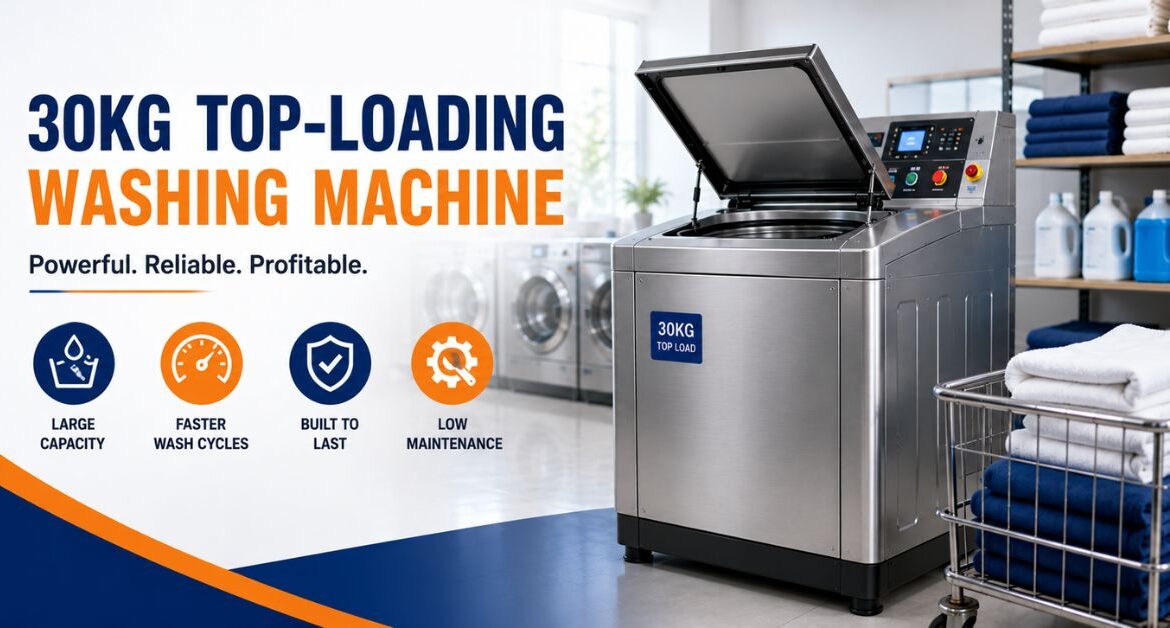
Running a laundry business, be it a small laundry at your local area or looking for expansion, your most important capital investment is your washing machine. No matter how good your locality or drainage system is, if you do not have the right washing machine for your business you will lose out. And the machine of choice for small to medium laundries across India is the 30kg top-loading washing machine.
30kgs was found to be the sweet spot for providing optimum capacity at the best price and efficiency. Majority of the small and medium laundries in India own at-least one 30kg top loading commercial washer.
Now the problem is, there are simply too many options out there. Thousands of suppliers offer a huge variety of models and specifications under the blanket term of ‘30kg top loading machine.’ So how do you choose which one is best for you and your business? Let this article be your complete guide to understanding your requirements and what you should be looking for in a 30kg washing machine.
What Is a 30kg Commercial Washing Machine?
30kg means 30 kilograms of dry cloth that the machine can wash in a single wash cycle. To give you an idea, that’s approximately 150-200 articles of clothing/bedsheets depending on the type and weight of clothes you have.
Top-loading means you put the clothes inside from above. In India, top loaders are found to be more convenient and faster than front loaders. Here the drum spins vertically and the clothes are agitated from above.
In India’s laundry industry, the 30kg capacity has become the sweet spot because it offers:
- Enough volume to handle regular daily loads without needing multiple machines for small operations
- Manageable space requirements in urban areas where real estate is expensive
- Lower water and electricity consumption compared to larger 50kg or 60kg machines
- Faster cycle times that allow operators to complete more loads per day
- More affordable initial investment and maintenance costs
Why Top-Loading Design Dominates the Indian Market
Top-loading commercial washing machines have become the standard across India, and there are specific reasons for this preference in our market context.
Key Advantages of Top-Loading 30kg Machines
- Faster cycle times: Top-loading machines typically complete wash cycles 15 to 20% faster than front-loading counterparts, allowing you to handle more loads daily and increase revenue.
- Easier loading and unloading: No need to bend down to access clothes. The operator-friendly design reduces physical strain during long working hours.
- Better for delicate fabrics: The gentler agitation method makes top-loading ideal for fragile textiles, important when handling premium customer garments.
- Lower operational complexity: Fewer mechanical components mean simpler maintenance and lower repair costs, which is crucial for small business sustainability.
- Water flexibility: Can operate efficiently with varying water quality and pressure, a significant advantage in different Indian regions with inconsistent municipal water supply.
- Compatible with existing Indian laundry workflows: Most established laundries were built around top-loading machines, so adding a 30kg unit maintains operational harmony.
Essential Features to Look For in a 30kg Top-Loading Commercial Machine
When evaluating suppliers and specific models, focus on these critical specifications:
- Build quality and materials: Stainless steel drum and body prevent rust and corrosion. At least 1.5mm thickness steel ensures durability in humid laundry environments.
- Motor specifications: Minimum 2.2 to 3.0 HP motor with thermal overload protection. Industrial-grade motors should have at least 5 to 7 years warranty.
- Wash program options: Minimum 8 to 12 wash cycles (heavy wash, normal, delicate, quick wash, soak, spin-only) to handle diverse customer requirements.
- Temperature control: Thermostat-regulated heating up to 70 to 80°C for sanitization and heavy-duty washing.
- Spin speed: Minimum 750 to 1000 RPM to adequately extract moisture, reducing drying time and saving electricity costs.
- Safety features: Lid locking mechanism, emergency drain valve, overload protection to prevent accidents and equipment damage.
- Warranty and after-sales support: Minimum 3-year warranty on major components. Verify spare parts availability with the supplier.
- Energy efficiency: Look for machines optimized for water and electricity consumption, reducing operational costs significantly over time.
Understanding These Specifications Matters
LaundroMentor guides entrepreneurs through exactly these technical considerations as they plan their laundry setups. The platform emphasizes that choosing the right equipment specifications upfront prevents expensive mistakes down the road. Many small operators make the critical error of purchasing machines without understanding these features, leading to higher operational costs and customer complaints later.
Top-Loading vs. Front-Loading: Making the Right Choice for Your Business
While front-loading machines have their place in premium laundry operations, the 30kg top-loading machine remains superior for most Indian laundries.
Why?
Front loaders are better suited for energy conservation and less water usage, especially when considering large scale volumes. On the other hand they demand more sophisticated infrastructure, increased capital expenditure (30 to 40% costlier than top loaders), longer cycles and time wise attention to get it levelled properly during installation. This adds to complexity when setting-up the unit in India, where space available in the facilities could differ.
Top loading 30kg machines are easier to install, need less technical know-how for day-to-day operations, offer quicker turnaround time and are more reliable during inconsistent power quality or water supply which is a common issue in India.
Owners servicing small to medium sized neighbourhoods, hotels/hospitals/offices prefer top loaders.
How to Select the Right Supplier for Your 30kg Washing Machine
The supplier you choose determines not just the price, but the entire experience, installation, training, spare parts availability, and after-sales service.
Criteria for Evaluating Suppliers
- Industry presence and credibility: Established suppliers with 5+ years in the commercial laundry equipment space offer better reliability.
- Local presence in India: Ensure they have service centers in your region for prompt repairs and spare parts availability.
- Original vs. imported components: Understand whether they assemble machines locally (often more affordable) or import directly (sometimes better quality consistency).
- Training and onboarding: Reputable suppliers provide basic training on operation and maintenance, protecting your investment.
- Spare parts ecosystem: Confirm availability of common replacement parts like belts, valves, drain filters, and heating elements.
- Customer references: Ask for contact information from existing customers. Direct feedback is invaluable.
- Warranty terms: Compare warranty duration and what components are covered (motor, drum, heating element, pump).
- Customization options: Some suppliers offer machines with additional features like automatic temperature control or digital timers at reasonable premiums.
LaundroMentor’s Business Setup Philosophy
Keep in mind that sites such as LaundroMentor exist because most new laundry entrepreneurs feel daunted by these choices. LaundroMentor is not a franchise. We are an organized system designed to help small and disorganized store owners gain access to information that has until now been reserved for chain laundries throughout India. Should you find yourself needing to make these equipment decisions for the first time, tips like this can come in handy.
Maintenance, Longevity, and Cost of Operations
A 30kg commercial machine is a significant investment, typically ranging from ₹1.5 to ₹3.5 lakhs depending on brand and features.
Daily Operational Practices
- Clean lint filters after every cycle to maintain efficiency.
- Check hose connections weekly for leaks.
- Monitor water quality. Consider installing basic filters to reduce sediment damage.
- Keep the machine level and stable to minimize vibration.
Monthly Maintenance
- Run cleaning cycles with descaling agents to remove mineral deposits.
- Inspect the drum for any sharp objects that could damage clothes.
- Check electrical connections for loose terminals.
- Verify all safety mechanisms are functioning properly.
Quarterly Professional Maintenance
- Have an authorized technician inspect the motor, pump, and drum.
- Replace worn-out gaskets and seals.
- Check heating element functionality.
- Balance and adjust drum alignment if needed.
With proper maintenance, a quality 30kg commercial washing machine typically lasts 8 to 10 years, delivering a cost-per-wash of approximately ₹3 to ₹5 once you account for electricity, water, and depreciation. This makes the investment economically sound for operations handling 30 to 50 customer loads daily.
Integration With Your Complete Laundry Business Setup
Buying a washing machine isn’t just about the equipment. It’s part of a larger business system.
The machine’s capacity, cycle times, and efficiency directly impact:
- How many employees you need
- Your facility’s total square footage requirements
- Electricity and water infrastructure needed
- Customer turnaround time commitments
- Revenue potential per day
- Drying and finishing capacity required
This is where planning tools and structured guidance become valuable. Many operators purchase equipment in isolation, only to discover their facility can’t support it effectively, or the machine’s throughput doesn’t match their operational capacity.
The Best 30kg Top-Loading Machines Share Common Traits
After years of market evolution, the most reliable machines share these characteristics:
1. Simplified Technology
The best machines use proven, uncomplicated mechanisms rather than newest gadgets that require frequent repairs.
2. Locally Serviceable
Components that technicians in your area can repair with standard tools and readily available parts.
3. Reasonable Spare Parts Costs
A replacement motor, pump, or heating element shouldn’t cost 30% of the original machine.
4. Honest Power Ratings
Machines that deliver their rated capacity without false claims.
5. Practical Documentation
Manuals written in understandable language with troubleshooting guides.
Conclusion: Making Your Investment Decision
The 30kg top-loading commercial washing machine represents the practical heart of laundry operations across India. It’s proven, reliable, and economically sound for small to medium-sized businesses. The key to success isn’t just buying the machine, it’s understanding your complete operational needs, selecting a trustworthy supplier with local support, and maintaining the equipment consistently.
If you’re new to the laundry business, take time to research not just the equipment but how it fits into your overall business model. Resources like LaundroMentor can help you think through the complete picture, from equipment selection to operational workflows to financial planning. Whether you’re upgrading an existing operation or starting fresh, the 30kg machine remains the logical choice for profitability and growth in India’s laundry industry.
Your washing machine is just the starting point. Treat it as an investment in your business’s ability to serve customers consistently and profitably.
Frequently Asked Questions
What's the difference between a 30kg machine labeled "industrial" vs. "commercial"?
The terms are often used interchangeably, but "industrial" typically implies machines designed for very high-volume daily use (100+ loads daily), while "commercial" is suitable for 30 to 50 loads daily. For most independent laundries in India, a 30kg "commercial" machine is appropriate and more cost-effective than industrial variants.
Can I install a 30kg commercial washing machine in a residential laundry space?
Yes, but with considerations. The machine requires dedicated 3-phase or heavy single-phase electrical supply, proper drainage with a floor drain or elevated outlet, and adequate ventilation. Space-wise, you'll need approximately 2m x 1.5m for the machine plus workspace around it. Structural load capacity must support 400 to 500kg equipment weight plus water weight.
How many customers can one 30kg washing machine handle daily?
If each customer's average load is 5kg, one machine running 10 cycles per day (assuming 30 to 40 minute cycles with loading/unloading time) can theoretically handle 60 customer loads daily. However, this assumes continuous operation and doesn't account for maintenance downtime, so realistic daily capacity is 40 to 45 customer loads.
What's the typical electricity consumption of a 30kg commercial washing machine?
A 30kg machine with a 2.5 to 3.0 HP motor typically consumes 2.5 to 4 units of electricity per cycle, depending on temperature settings and cycle duration. At ₹6 to ₹8 per unit, electricity cost per cycle runs approximately ₹15 to ₹32. This should factor into your customer pricing structure.


