

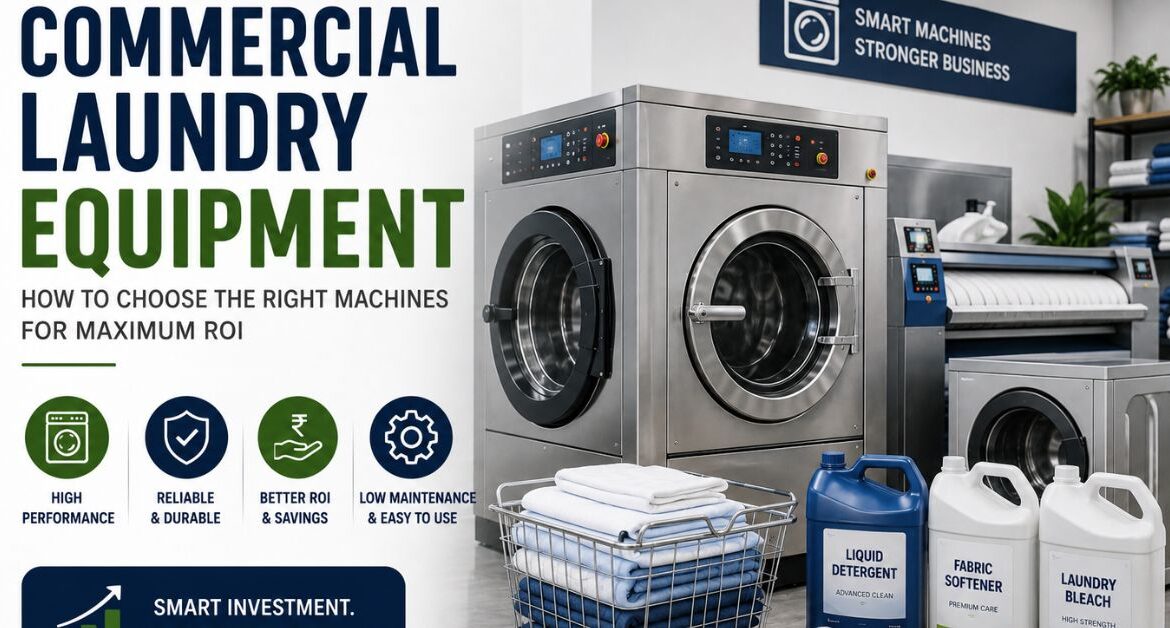
If you’re new to the laundry business, purchasing equipment will likely be your largest single expense when starting up and often the decision that will dictate whether your business becomes profitable in a timely fashion or suffers from missteps taken during its infancy. Commercial laundry equipment isn’t your household washer and dryer that runs a couple hours each day. These machines are designed to keep busy schedules, accommodate different types of loads, and produce large volumes of laundry day after day. This is one very obvious factor that will alter your approach when deciding what to buy.
So what DOES impact your ROI when it comes time to purchase laundry equipment? In this blog we’ll cover just that. We want you to be armed with the right knowledge when it comes time to decide which equipment best suits your needs. After all, you wouldn’t build a house by blindly picking the cheapest materials, would you? Think of this as DIY for laundry businesses.
Why ROI Thinking Matters More Than Upfront Price
When buying laundry equipment for the first time for your business, it can be very easy to look at the purchase price of the machines and go with the least expensive one. However, the actual costs of a piece of equipment are realized over time through power draw, water use, frequency of service requirements, downtime due to repairs or failure and time until you need to replace the machine.
Oftentimes, a machine that costs a few hundred dollars more can pay for itself in 12-18 months by simply running longer with less downtime due to its energy efficiency, build quality and reduced service requirements. That is ROI thinking.
Understanding Different Types of Commercial Laundry Equipment
It’s useful to get familiar with the general types of equipment options available before narrowing your focus to specific brands and models. Keep in mind that different laundry business models will utilize different combinations of equipment types. : …With laundry equipment in general, there are several main categories to consider. The most obvious are washers and dryers. Washers can come in front-load or top-load models, and range from small commercial units all the way up to large- capacity units for heavy-duty use. Dryers are obviously only necessary if you need to offer dry cleaning or if your water humidity and air-drying process will not meet your desired turnaround time. (This is very rarely an issue if you’re located in a dry climate or during dry seasons.) If you plan to offer finishing as part of your service, pressing and ironing equipment will be required to produce a finished look. Flatwork ironers or steam presses are examples of this type of equipment. Dry cleaning equipment is another category entirely, as these machines are designed specifically for solvent-based cleaning.
Key Factors That Directly Impact Equipment ROI
Several interconnected factors determine whether a piece of commercial laundry equipment delivers strong returns or becomes a costly liability over time.
- Load capacity matched to actual demand — Oversized machines running under half-full loads waste water, electricity, and detergent, while undersized machines create bottlenecks and force customers to wait longer than competitors offering faster turnaround
- Energy and water consumption ratings — Since utilities are a recurring daily cost, machines with better efficiency ratings can meaningfully reduce operating expenses over months and years of continuous use
- Cycle time efficiency — Faster wash and dry cycles allow a single machine to process more loads per day, directly increasing daily revenue capacity without additional equipment investment
- Build quality and expected lifespan — Commercial-grade components designed for heavy daily use tend to outlast budget alternatives, reducing the frequency and cost of replacement
- Availability of spare parts and local service support — Equipment requiring parts or technicians from distant cities can lead to extended downtime during breakdowns, directly affecting daily revenue
- Warranty terms and after-sales support — Comprehensive warranty coverage reduces unexpected repair costs during the equipment’s early operational years
- Ease of staff training — Machines with intuitive controls reduce training time and lower the risk of operational errors that can damage garments or waste resources
Calculating Realistic ROI Before Purchase
Don’t let ROI analysis scare you. Many people avoid doing ROI calculations because they assume it’s an elaborate financial model. In reality, you can get a ballpark figure by taking your total upfront costs (machine costs, installation, facility changes, etc.) and dividing that by the projected monthly income you expect to receive (based on your anticipated load count and price point).
Minus your ongoing costs for utilities, chemicals, labor, and maintenance and you should have a monthly number you can divide your total cost into to see how many months it will take to pay off. This method is usually good enough to compare multiple machines before making an investment. Be sure to factor in a few slow months, as most laundromats won’t have 100% capacity when you first open.
New Equipment vs. Refurbished: An ROI Perspective
The decision between new and refurbished commercial laundry equipment often comes down to available capital versus risk tolerance, and both options can make sense depending on the specific business stage.
New equipment typically offers longer expected lifespans, updated energy efficiency standards, and full manufacturer warranties, which can translate into lower long-term operating costs and fewer unexpected repair expenses. Refurbished equipment, on the other hand, significantly reduces upfront capital requirements, which can be particularly useful for entrepreneurs testing a new location or business model before committing to a larger investment.
From a pure ROI standpoint, refurbished equipment can sometimes offer a faster payback period simply due to lower initial cost, provided the equipment is sourced from a reliable vendor with some form of service guarantee and hasn’t already reached the later stages of its realistic operational lifespan.
Common Equipment Selection Mistakes That Hurt ROI
Several recurring mistakes tend to quietly erode ROI for new laundry businesses, often without the owner realizing the impact until months later.
- Purchasing based purely on lowest quoted price without factoring in long-term running costs
- Buying capacity far beyond current demand in anticipation of future growth that takes longer than expected to materialize
- Skipping preventive maintenance schedules, leading to more frequent and costly breakdowns
- Ignoring local electricity and water tariff structures when estimating ongoing operating costs
- Failing to negotiate service and warranty terms clearly before finalizing a purchase
- Underestimating installation and facility modification costs, such as electrical upgrades or drainage changes
- Not accounting for machine downtime during routine servicing when calculating expected daily capacity
Avoiding these mistakes during the initial procurement phase can meaningfully shorten the actual payback period compared to projections made without considering these operational realities.
Matching Equipment Choices to Your Business Model
The expected ROI, volume capacities needed, and laundry equipment specifications will vary by type of laundry business you are looking to start. With self-service laundry businesses, you want machines that will withstand constant use by the public and be simple to use. Washers and dryers for full-service laundry businesses can often have larger loads since the public will not be using them, and dryers can run faster since clothes are bundled by a worker instead of folded by yourself.
Industrial laundry businesses that service facilities like hotels and hospitals will need commercial equipment able to withstand high usage volumes and can usually spend more money upfront because they know where their steady stream of business will be coming from. Laundry businesses that focus on dry cleaning or other specialty services may not need to wash or dry as many clothes at one time. Knowing your needs based on the type of laundry business you want to open will eliminate many machines from your selection.
Where Structured Guidance Helps: The Role of LaundroMentor
With so many factors that go into equipment sizing — how much to size for (capacity planning), energy use (efficiency ratings), parts availability (service), realistic expectations on return on investment — it’s no surprise that many new entrepreneurs who are considering starting a laundry business feel overwhelmed, especially if they don’t have experience working in a laundry already. That’s where resources like LaundroMentor come in handy.
LaundroMentor is not a franchise. Think of it more as a comprehensive guide and ongoing support system for starting and operating your own private laundry business, as opposed to purchasing into a named franchise. LaundroMentor focuses on providing small and disorganized store owners (a majority of laundries in India) with access to systems, operations knowledge and equipment advice that is used by large organized laundry chains.
Entrepreneur’s machine section offers a high-level look at categories of equipment that you might need, based on your laundry business model. This can be a good starting point for laundromat owners when cross-referencing the machines you find in the market. It’s especially helpful if you don’t have anyone in your contacts who works in the laundry industry already and are looking to make a large capital expenditure.
Long-Term Maintenance and Its Role in Sustaining ROI
Equipment ROI doesn’t end once a machine is installed and operational — it’s sustained or eroded through ongoing maintenance practices over the following years. Establishing a preventive maintenance schedule, rather than waiting for breakdowns to prompt servicing, tends to significantly extend equipment lifespan and reduce unexpected repair costs.
- Schedule routine inspections for belts, motors, and seals to catch wear before it causes major failures
- Keep detailed maintenance logs to identify recurring issues with specific machines
- Train staff on proper loading practices to avoid unnecessary mechanical strain
- Address minor issues promptly rather than allowing them to escalate into costly repairs
- Budget a small monthly reserve specifically for maintenance and eventual part replacement
Treating maintenance as a planned, budgeted activity rather than a reactive expense tends to protect the ROI calculations made at the time of initial purchase.
Final Thoughts
The purchase price is just one factor you’ll want to consider when purchasing commercial laundry equipment. Others include (but are certainly not limited to) load size, energy use, durability, serviceability, and equipment that fits your business model. All of these factors contribute to either becoming a quick money pit or enhancing your ROI for years to come.
Investing the time up front to carefully weigh your options in a logical, numbers-driven way will always be more beneficial than making snap decisions or simply buying whatever a salesperson tries to pitch to you. If you’re looking for extra guidance along the way, LaundroMentor is here to help. We provide laundry owners in India with no-nonsense advice they can use to make better decisions for their business from day one.
Frequently Asked Questions
Is it better to buy new or refurbished commercial laundry machines?
New machines offer longer lifespans and full warranties, while refurbished machines can lower upfront investment and sometimes offer a faster payback period if sourced reliably.
How long does it typically take for laundry equipment to pay for itself?
Payback periods vary based on business model and volume, but calculating projected monthly revenue against upfront and recurring costs gives a realistic estimate specific to your setup.
Does regular maintenance really affect ROI?
Yes, preventive maintenance reduces unexpected breakdowns and downtime, both of which directly protect the equipment's earning capacity over its operational lifespan.
Does LaundroMentor sell laundry machines directly?
LaundroMentor is not a franchise or direct machine manufacturer. It provides structured guidance, systems, and support—including equipment-related resources—to help individuals set up and run their own independent laundry businesses.

Aman Sawaran is a leading laundry business consultant who has personally guided over a hundred laundromat owners to success. With years of hands-on experience in the laundry industry, Aman specializes in helping entrepreneurs build and scale profitable laundromats and pick-up & delivery laundry businesses. His step-by-step consulting program covers everything from selecting the ideal distributor and perfect location to securing financing and launching a state-of-the-art laundromat within just 3 to 6 months. Ready to transform your laundry business idea into a thriving venture? Aman can show you how to launch, scale, and maximize your profits with proven strategies and expert guidance.


