

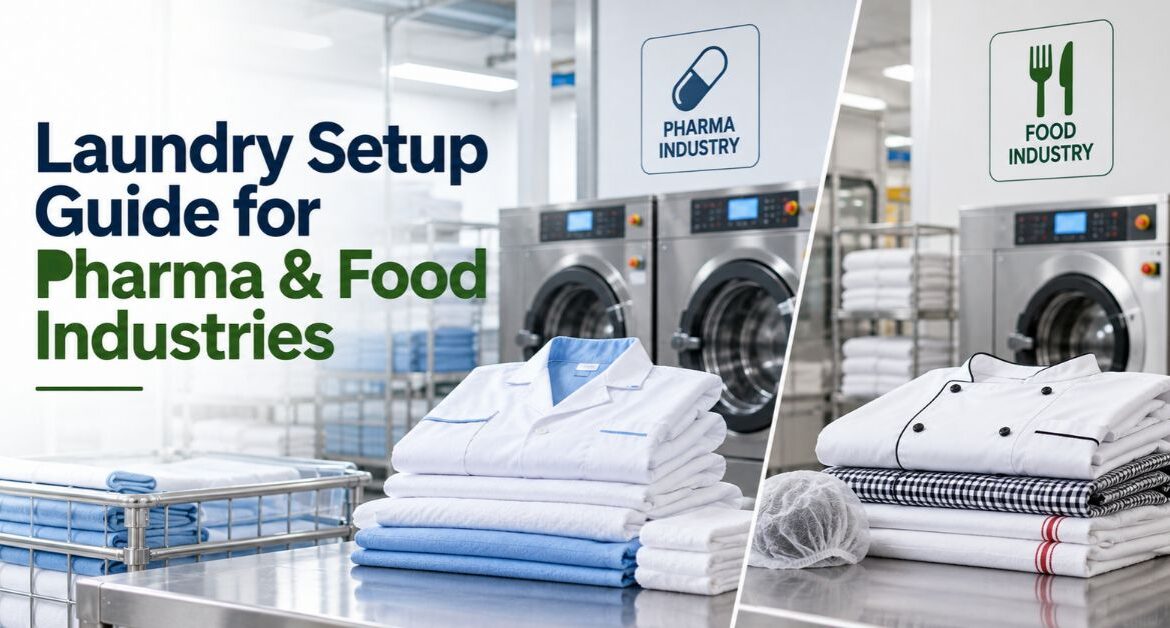
It’s possible to look clean in uniform and still not be suitable for a production area. Marks left by detergent, loose fibres, food allergens, or contaminants from packing can cause problems missed by a visual assessment.
Equipment, garment handling, process control, and clean storage conditions are important topics for laundry owners interested in servicing these industries.
We’ll start by introducing the pharma and food manufacturing environments, then explore setup considerations in ten steps.
Background for Laundry Equipment & Chemicals
The first stage of assessing new industries is learning about the risks and customer expectations. Our Laundry Guide has an outline of laundry machine selection which provides context for the technical topics below.
1. Determine Which Garments Will Be Processed
“Pharma laundry” and “food industry laundry” are services with different levels of care. Determine your scope:
- Which departments wear the garments?
- What substances might contaminate them?
- Are they reusable clothing, or specially designed for the proposed process?
- Does cleaning ensure they’re clean, or must they be disinfected/sterile?
- Who confirms processing standards are met and approves release?
Garment stream
Main planning concerns
| Garment stream | Main planning concerns |
|---|---|
| General pharmaceutical workwear | Product residues, garment suitability, controlled handling |
| Sterile- manufacturing cleanroom garments | Particle control, garment integrity, sterilisation where necessary |
| General food-production workwear | Soil removal, hygiene and protective quality after washing |
| Workwear from higher hygiene food areas | Area segregation and customer-defined contamination controls |
| Clothing exposed to hazardous substances | Containment, worker protection and specialist processing which meets required approvals |
Don’t agree to clean workwear that could have unfamiliar contamination “just because your machines can wash the material.”
2. Learn about Pharma Laundry vs Food Laundry
Pharmaceutical garments
The customer should advise what garments are used, their release criteria, and any required approval process. Pharmaceutical manufacturers may have procedures based on EU GMP Annex 1. It describes conditions for qualifying laundering facilities, inspection before packing and controls on laundry/ sterilisation cycles. Garment sterilisation is also specified where required for particular aseptic areas.
This is not a laundry specification for every Indian pharmaceutical manufacturer. Consider it as a useful technical reference where it applies.
The Schedule M also includes guidance for laundry equipment and services which contact hazardous-products clothing. It covers requirements for safe bagging, protecting laundry workers and prevention of cross contamination with other garments.
Food Industry garments
Hygiene for food operations means having appropriate workwear and managing its use. Hygiene controls depend on what’s produced, where it’s exposed during production, and the different risk zones employees enter.
Food Hygiene India has a good example of sector-specific guidance for health supplements/nutraceuticals. The FSSAI guidance states cleaning operators must use suitable clean workwear which is kept in good condition. They must launder workwear at agreed intervals.
Bear in mind this advice was not created as a specification every food business must follow. Workwear needs will vary.
Confirm your services align with the customer’s food-safety managers. Discuss garment controls, including any allergen risk and hygiene zone rules that apply.
3. Plan the Process Layout Around Used and Clean Garments
Plan laundry operations so items can move from collection to delivery without compromise. Your layout should easily accommodate areas for:
- Receiving and holding dirty laundry.
- Sorting and identifying which garment groups are processed.
- Washing and extraction.
- Drying, inspection, and finishing.
- Secure packing and storage before dispatch.
- Loading trucks or containers for dispatch.
Mixing up used garments with packaged clean stock can create many types of contamination. Plan your layout so both flows remain separate until garments leave your laundry.
This includes employee traffic too. Position doors or walls so people can follow proper procedures without short-cutting garment-handling processes. If they carry dirty workwear through a clean area without changing, you’ve just bypassed your own controls.
Provide space to store rejected or unidentified garments until they can be examined. Decide what to do with them before they blend in with your released stock.
Room airflow, cleanliness grading, and pressure differentials are designed per project. Protecting clean garments from hazardous substances may require different controls than other products.
4. Choose Equipment to Meet Your Process
Avoid selecting a supplier’s pre-configured package without a written requirement.
| Equipment or system | Item to consider |
|---|---|
| Washer-extractors | Programmable sequences, construction materials, load size range and ease of cleaning |
| Barrier washers, where appropriate | Layout integration with dirty-to-clean workflow and Standard Operating Procedures (SOPs) |
| Chemical dosing equipment | Accurate repeat doses, calibration and fault alerts |
| Dryers | Textile/material compatibility, temperature controls and required airflow quality |
| Garment inspection and packing stations | Easy-to-clean surfaces, lighting and prevention of contamination |
| Water treatment system | Capability to reach your agreed water quality parameters |
| Tracking system | Ability to record batch ID, processing history and release status |
| Sterilisation equipment, where needed | Customer approval that it works with the selected garments, packaging and load sizes |
Equipment position follows the process flow. You may choose to stack washing and drying machines based on equipment dimensions alone, only to find clean garments pile up at packing.
A barrier washer enables physical separation. Simply adding the equipment does not make your laundry compliant.
Likewise, purchasing an autoclave doesn’t prove sterilising packaged garment loads is effective.
5. Estimate Required Capacity From the Workflow
Machine specs should match garment loading guidelines and the full cycle time.
Using made-up numbers as an example:
400 garments per day x 0.6 kg per load = 240 kg of laundry per day
If each load is limited to 20 kg based on the approved process, the total quantity could be as few as 12 distinct loads. Remember to allow for segregation, cleaning failures, downtime and spikes in demand.
We don’t recommend these figures define individual machine sizes. Loading restrictions might include worker protection during washing/drying and the amount of space needed for packing boxes.
Inspect whether drying, inspection, and packing activities can manage that quantity of laundry. You could have a very large washer that constantly creates a bottleneck before clean garments are packed.
Garment storage before use is also a consideration. Will the customer have enough garment sets to cover wearing, collection times, processing, and an agreed cushion?
6. Establish Water Usage, Drainage and Utilities
Ask machinery suppliers what utilities they require during normal operations.
Include details of:
- Peak water demand vs available supply pressure.
- Required wash water and rinse water quality.
- Electricity supply capacity and methods of heating water.
- Dryer ventilation requirements and resulting heat load in process rooms.
- Ability for floor drainage to cope and locations for access doors.
- The properties of wastewater produced and preferred treatment methods.
Different pharmaceutical garment loads do not use the same wash water specification. Establish what makes sense for the substances being removed, residue tolerances, and garment care.
Keep in mind you’re not simply transferring contaminants from clothing into the wastewater system. Look at what happens when residues are removed; they may enter wash water, filter vessels, or other media.
7. Write a Process Specification
Document the process for each type of garment you agreed to launder. Capture details on how they will be loaded, washed, inspected, and accepted.
Loading patterns, chemistry dosing, water quality, temperatures used, timing, agitation, rinses and drying method all form part of the process. Specify what determines a garment passes or fails.
The chemistry you use should be compatible with both the textiles and any contaminants expected. A pleasant smell or clean appearance is not proof cleaning has occurred.
Validation of the process should demonstrate it consistently delivers the desired result. Validation may include:
- Removal of soils or residues.
- Microbiological performance.
- Particle control.
- Allergen removal.
- Maintenance of garment condition after repeated processing cycles.
Methods of validation and acceptance limits will be agreed with the customer. Ensure you are actually validating the required activity; just because you run a microbial test does not validate cleaning or that allergens were removed. Seeing clean clothes is not the same as demonstrating they are sterile.
Any adjustments to garments, processing chemicals or key equipment settings should trigger a review.
Formal methods of updating your process follow best practice. Traceability of changes is also useful if issues occur later.
8. Confirm Garment Identity and Release Status
Create an auditable history for each load or batch of garments.
Track the customer/supply department, what type of garment, how many were collected, the process used, who completed the work, what they found during inspection, and the decision to release.
Batch and garment identity is important with reusable cleanroom garments. They may require individual lifecycle records. Tools like barcoding or RFID offer great ways to track identity. Scanning a garment does not confirm it was cleaned or sterilised.
Release also needs stages; keep these statuses unique:
- Received
- Processing
- Hold – investigation or rewash required
- Inspected
- Released
- Retired
Failed batches should not be released simply because someone checked off that cycle as complete.
9. Ensure Clean Garments Are Protected after Washing
Soiled garments receive a lot of attention. Once they’re clean, there’s still more work to be done to keep them that way.
Consider packaging types, containers for storing clean garments, how reusable transportation containers are cleaned, and required storage conditions.
Clean garments should be kept away from soiled ones. That includes packing/loading areas. If the same vehicle transports clean & used garments, agree on cleaning & separation methods first.
Sterile garments add packaged integrity and storage-time limits to consider. For food companies, packaging may have conditions to meet based on the hygiene level where clothes will be worn.
10. Decide if Processing Will Be Outsourced
Keeping operations in-house gives you control but still needs space, employees to run it, utilities, and technical management.
If equipment is going to be supplied by a laundry service, verify they have the required skills first.
Questions to ask before using a 3rd party service:
- What garment types and contaminants do they accept?
- Do they have dedicated processing for different risks?
- Can they show the process was completed correctly?
- How will the clean garments be transported to the customer?
- Do they have a backup plan should the equipment fail?
- What’s their procedure for subcontracting work or notifying you of changes?
Commit these details to a service and quality agreement. Decide who investigates faults, approves rewash, replaces damaged garments, and can release clean stock for use.
Areas to avoid when starting laundry services
Common mistakes include purchasing equipment before determining the garment group, using one cleaning process for different risks, and assuming all pharma garments need sterilisation.
Mixing garment types that require separation, allowing employee traffic to contaminate clean areas, missing lifecycle records, packaging garments before they’re ready, and dispatching without release are other examples.
Summary
Cover garment requirements first, then allow facility design, machinery, and documented processes to follow. Visit the customer factory and discuss garment use with their quality or food-safety teams.
Once agreed, design your workflow to meet requirements and verify it works. Approaching setup with this preparation positions your laundry to provide dependable service.
FAQs

Aman Sawaran is a leading laundry business consultant who has personally guided over a hundred laundromat owners to success. With years of hands-on experience in the laundry industry, Aman specializes in helping entrepreneurs build and scale profitable laundromats and pick-up & delivery laundry businesses. His step-by-step consulting program covers everything from selecting the ideal distributor and perfect location to securing financing and launching a state-of-the-art laundromat within just 3 to 6 months. Ready to transform your laundry business idea into a thriving venture? Aman can show you how to launch, scale, and maximize your profits with proven strategies and expert guidance.


