

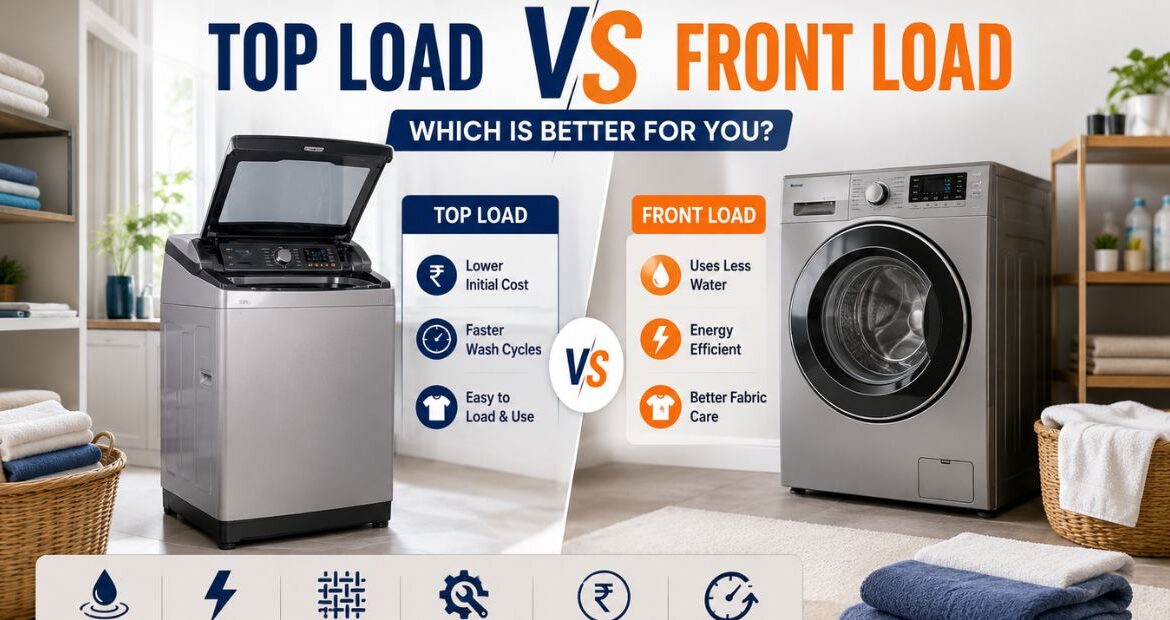
“Which is better, top load or front load?” is one of the most searched questions in the laundry equipment space, and for good reason. It is a decision that affects daily convenience, fabric care, electricity bills, water consumption, and long term maintenance costs. Yet most answers online either oversimplify the comparison or push a particular machine type without acknowledging that the correct answer is genuinely context dependent.
The reality is that neither machine type is universally superior. Each has a distinct engineering philosophy, and each performs better under specific operational conditions. A top load machine that is ideal for a water scarce household in a Tier 2 Indian city may be completely wrong for a commercial laundry store handling 100 kg of mixed garments per day. A front loader that delivers outstanding results for hotel linen may be unnecessarily expensive and slow for a household that runs three loads a week.
This guide cuts through the noise and gives you a structured, honest comparison across every dimension that actually matters, so you can make a decision grounded in your specific situation rather than a generic recommendation.
How Top Load and Front Load Washing Machines Actually Work
Before comparing performance, it helps to understand the fundamental mechanical difference between the two machine types, because the physics of how they clean is at the root of every other difference.
Top Load Washing Machines
In a top load machine, the drum or wash tub is oriented vertically, clothes are dropped in from the top. The machine fills with a relatively large volume of water, submerging the entire load. Cleaning action is generated either by a central agitator (a rotating post that physically pushes and pulls garments through the water) or by an impeller (a low profile rotating disc that generates strong water currents).
Front Load Washing Machines
In a front load machine, the drum is horizontal and rotates on a horizontal axis. Clothes tumble through a relatively small amount of water at the bottom of the drum, lifted and dropped repeatedly by the drum’s rotation. Gravity does the work, garments are repeatedly lifted and allowed to fall back into the water, creating a compression and release action that works detergent deep into fabric fibres.
Head to Head Comparison: Top Load vs Front Load
| Dimension | Top Load | Front Load |
| Water consumption | Higher (100 to 200L/cycle) | Lower (50 to 100L/cycle) |
| Energy consumption | Moderate | Lower per kg washed |
| Wash cycle time | Shorter (30 to 45 min) | Longer (45 to 90 min) |
| Fabric care | Moderate (agitator) / Good (impeller) | Excellent |
| Spin speed (RPM) | 400 to 800 RPM | 800 to 1,400 RPM |
| Water extraction | Moderate | Superior |
| Ergonomics | Easy top loading/unloading | Requires bending |
| Upfront cost | Generally lower | Generally higher |
| Long term running cost | Higher (water + energy) | Lower |
| Maintenance complexity | Lower | Door seal cleaning required |
| Space requirement | Larger footprint | Stackable, smaller footprint |
| Detergent type | Standard detergents | HE (low foam) detergents |
| Mid cycle additions | Yes (most models) | No (most models) |
| Best for commercial use | Heavy cotton, workwear | High volume mixed garments |
Water and Energy Efficiency: Where the Real Cost Difference Lies
For household users running two to four wash loads per week, the water and energy cost difference between top load and front load machines is noticeable but not dramatic. For commercial laundry operations running 8 to 15 cycles per day, it is substantial.
Front load machines typically use 40 to 50 percent less water per cycle than equivalent top load machines. Over the course of a year in a commercial setting, this translates into a significant reduction in water bills, particularly relevant in Indian cities where commercial water tariffs are high and water availability is inconsistent.
On the energy side, front loaders are more efficient for two reasons. First, they heat less water per cycle (less water volume means less energy required to reach wash temperature). Second, their higher spin speeds extract more water from garments before drying, reducing the time and energy the dryer needs to complete the job. For operations using gas or electric dryers, this downstream energy saving is often underestimated in cost calculations.
Fabric Care: Which Machine Is Gentler on Clothes?
This is where the mechanical difference between the two machine types has the most direct impact on laundry quality, and where the context of use matters most.
For Delicate Fabrics, Formal Wear, and Mixed Loads
Front load machines win clearly. The tumbling action does not stretch, twist, or stress garment fibres the way an agitator mechanism can. Silks, woollens, synthetic blends, delicate dress materials, and formal shirts all fare better in a front load drum. This is why premium hotels, dry cleaning outlets, and garment finishing services almost universally use front load machines for their core washing operations.
For Heavy Cotton, Linen, Workwear, and Institutional Garments
Top load machines with agitators perform well and are often preferred. The aggressive mechanical action is effective at dislodging heavy soil, embedded dust, and oil stains from cotton uniforms, hotel kitchen linen, and industrial workwear. For facilities processing these garment types in high volume, the cleaning effectiveness and shorter cycle time of a top loader can outweigh the fabric care advantage of a front loader.
For Commercial Laundry Stores Handling Mixed Garment Types
Mixed garment commercial operations benefit most from front loaders because the range of garment types, including formal shirts, synthetic blends, children’s clothing, and household linen, demands the gentler tumbling action. Running delicate garments through an agitator based top loader consistently produces customer complaints and garment damage claims over time.
Maintenance Requirements: What Each Machine Type Demands Over Time
Maintenance burden is a frequently overlooked factor in the top load vs front load decision, particularly for commercial operators who cannot afford extended machine downtime.
Top Load Machine Maintenance
Top loaders are generally simpler to maintain. They have fewer sealing components (no door gasket), the drum and tub are easily accessible for cleaning, and the mechanical systems are less complex than front load equivalents at comparable capacity.
The primary maintenance requirements are:
- Cleaning the lint filter regularly
- Descaling the tub in hard water areas
- Checking the agitator or impeller mechanism for wear
Front Load Machine Maintenance
Front loaders require more diligent ongoing maintenance. The rubber door gasket (seal) accumulates moisture, detergent residue, and lint, creating conditions for mould and bacterial growth if not wiped dry after each use and cleaned weekly.
The maintenance requirements include:
- Cleaning the door gasket regularly
- Removing and cleaning the detergent drawer
- Cleaning the drum filter periodically
- Using only HE (high efficiency) low foam detergents
Using standard high foam detergents creates excess suds that can damage the machine and reduce wash quality over time.
Choosing Between Top Load and Front Load: A Use Case Decision Guide
Rather than declaring one machine type universally better, the right approach is to match the machine to the operational context.
Recommended Choices
- Household with irregular water supply or frequent power cuts:
Top load machine. Simpler operation, easier to pause mid cycle, and less sensitive to water pressure fluctuations. - Household prioritising fabric care for mixed or premium garments:
Front load machine. The tumbling action protects delicate fabrics and produces better results for formal wear and synthetic blends. - Household with limited floor space and a need for stacking:
Front load machine. Can be wall mounted or stacked with a dryer, saving significant floor area. - Small commercial laundry store handling everyday garments:
Front load commercial machine (10 to 15 kg capacity). Better fabric care, lower running costs, and more suitable for mixed garment types. - Hotel linen room or hospital laundry handling heavy cotton loads:
Commercial top load or hard mount front load washer extractor, depending on volume and fabric type mix. - Industrial workwear laundry processing heavily soiled uniforms:
Top load commercial machine with agitator. The aggressive mechanical action handles heavy soiling more effectively. - Laundry business prioritising throughput speed over running cost per cycle:
Top load machines for their shorter cycle times, multiple machines in parallel to maximise daily capacity. - Laundry business prioritising long term profitability and lower running costs:
Front load machines. The water and energy savings compound significantly over high volume commercial operation.
How LaundroMentor Helps Laundry Business Owners Make the Right Machine Decision
The top load versus front load decision is straightforward for a household but genuinely complex for a commercial laundry operator. The wrong choice at the equipment procurement stage affects daily operations, running costs, customer satisfaction, and business profitability for years. This is precisely where structured guidance makes a material difference, and it is one of the core areas where LaundroMentor provides value to laundry business owners across India.
LaundroMentor is not a franchise. It is an independent knowledge and support platform built specifically for small and unorganized laundry store owners in India who want to build professional, well structured operations. The platform provides the kind of operational intelligence that established laundry chains develop through years of experience, covering equipment selection, workflow design, staff training, pricing, and quality control, and makes it accessible to independent operators starting from scratch.
If you are in the process of setting up or expanding a laundry business in India and want guidance on equipment decisions grounded in practical experience, visiting laundromentor.com is a logical and useful starting point.
Common Myths About Top Load vs Front Load Washing Machines, Debunked
Myth: Front load machines always clean better than top loaders
Reality: Front loaders clean more gently and efficiently for most garment types, but top loaders with agitators can outperform front loaders for heavily soiled industrial or kitchen linen where aggressive mechanical action is needed.
Myth: Top load machines are always cheaper to run
Reality: Top loaders have lower upfront costs in most cases, but their higher water and energy consumption per cycle makes them more expensive to operate over time, especially in commercial settings with high daily cycle counts.
Myth: Front load machines are too slow for commercial use
Reality: While individual cycle times are longer, front loaders’ higher spin speeds mean garments dry faster, reducing the total time from wash to finished garment. For many commercial operations, the net throughput difference is minimal.
Myth: Top loaders are always easier to maintain
Reality: Top loaders are generally simpler to maintain at the household level. At the commercial level, the maintenance requirements of both machine types are more comparable, and front loaders’ longer operational life cycle can offset their higher maintenance diligence requirements.
Myth: You can use any detergent in a front load machine
Reality: Front load machines require HE (high efficiency) low foam detergents. Standard detergents produce excess suds that reduce wash quality, trigger error codes, and can damage internal components over time.
Conclusion
There isn’t one right answer for the front load vs top load debate, there is a right answer for each individual scenario. The needs of a family living in a water-starved city on a budget with unstable electricity are vastly different than that of a commercial laundry shop washing 80 KG daily of mixed garments for high-end residential clients.
The key is knowing the actual day-to-day advantages and disadvantages of each type of machine and weighing those against your specific situation, your expected laundry load, garment types, available facilities, budget and long-term cost considerations. When you evaluate this information realistically you will be left with a clear choice of what type of machine is right for you.
Here at Burbero our goal is to help commercial laundry owners in India navigate these choices with guided assistance, not just for individual pieces of equipment but for every aspect of setting up a professional laundry business. So if you’re thinking of starting or expanding a laundry business it’s always better to seek out knowledgeable advice before investing any money.
Frequently Asked Questions
Is a top load washing machine better for Indian conditions?
Top load machines have traditionally been popular in India due to their lower upfront cost, simpler operation, and tolerance for irregular water supply and power fluctuations. However, front load machines have become increasingly practical and affordable in Indian urban markets, and their lower running costs make them the better long term investment for many households and commercial operators.
Can I add clothes mid cycle in a front load washing machine?
Most front load machines lock the door once the cycle starts and the drum fills with water, making mid cycle additions impractical in standard operation. Some newer models include a pause and add feature that allows a brief window to add forgotten items early in the cycle. Top load machines generally allow additions at any point before the spin cycle begins.
Which machine type is better for a commercial laundry store in India?
For most commercial laundry stores handling a mix of everyday garments, front load commercial washer extractors are the preferred choice. They deliver superior fabric care for mixed loads, consume less water and energy per kilogram washed, and produce better extracted garments that require less drying time.
Does LaundroMentor help with equipment decisions for laundry businesses?
Yes. LaundroMentor is a structured knowledge and guidance platform for independent laundry business owners across India. It provides operational guidance on equipment selection, workflow design, pricing, and quality control, the same knowledge that established laundry chains develop internally. It is not a franchise. Visit laundromentor.com for more information.


