

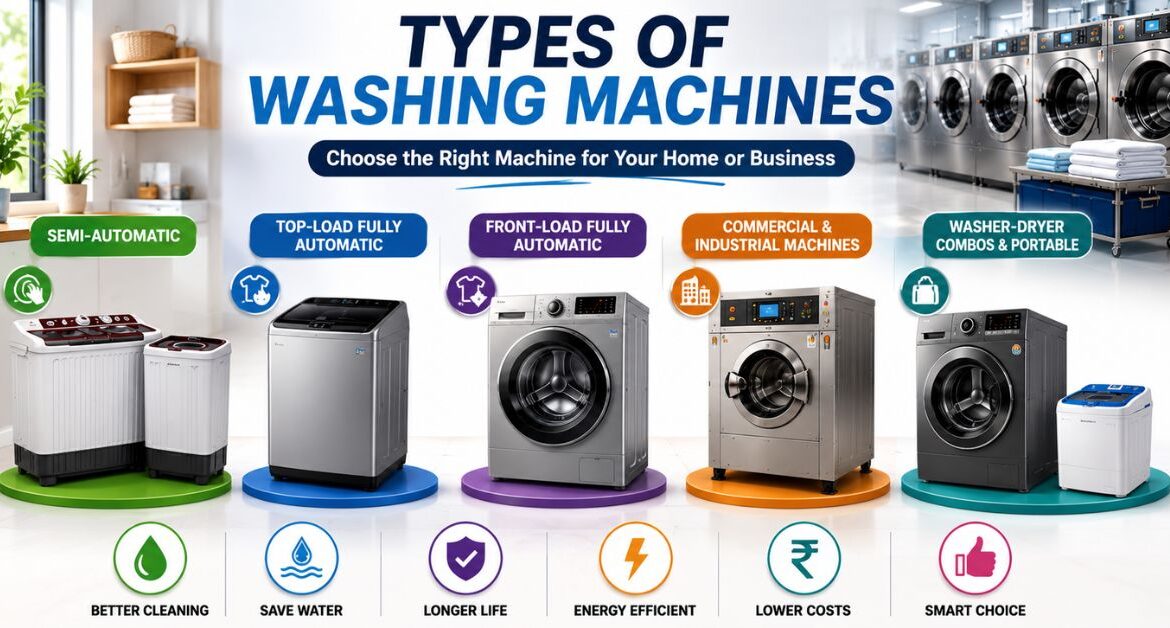
Washing machines are no longer a luxury, they are a daily operational tool for millions of households and a critical investment for commercial laundry businesses across India. Yet most people choose a washing machine based on price or brand reputation alone, without understanding the fundamental differences in machine types and how those differences directly impact cleaning performance, fabric care, water usage, electricity consumption, and long-term maintenance costs.
Whether you are a household buyer trying to pick the right machine for your family’s needs, or a laundry business owner evaluating equipment for your store, understanding the different types of washing machines is the starting point of every smart decision. This guide covers all major washing machine types in detail, how they work, what they are best suited for, their advantages, and their limitations.
The Three Primary Categories of Washing Machines
At the broadest level, washing machines are classified into three categories based on how the drum or wash tub is oriented and how the agitation mechanism works:
- Top-Load Washing Machines (with Agitator or Impeller)
- Front-Load Washing Machines
- Semi-Automatic Washing Machines
Within these categories, there are further subcategories, including fully automatic, twin-tub, washer-dryer combos, portable machines, and commercial-grade machines. Each type serves a different user profile, and choosing the wrong one can result in poor cleaning results, high running costs, or premature equipment failure.
1. Semi-Automatic Washing Machines
How They Work
Semi-automatic washing machines require manual intervention at multiple stages of the wash cycle. The user fills the wash tub with water manually (or through a pipe connection), adds detergent, sets the timer, and then transfers the wet clothes to a separate spin tub once the wash cycle is complete. The spin tub extracts water through centrifugal force before the clothes are hung to dry.
Types of Semi-Automatic Machines
Single Tub
- Combines washing and spinning in one tub, requiring the user to switch between functions manually.
Twin Tub
- The most common semi-automatic design in India.
- Has two separate tubs, one for washing and one for spinning, allowing simultaneous operation of both functions.
Best Suited For
- Households with irregular water supply
- Buyers looking for an affordable entry-level machine
- Areas with frequent power cuts, as partial use is possible
- Small laundry operations handling basic cotton and synthetic garments
Limitations
- Requires physical effort and monitoring throughout the cycle
- Not suitable for delicate or heavily soiled fabrics without careful supervision
- Water efficiency depends on user behavior, not machine programming
2. Top-Load Fully Automatic Washing Machines
How They Work
Top-load fully automatic machines allow you to load clothes from the top of the drum. Once the load is in and settings are selected, the machine manages the entire process, water filling, washing, rinsing, and spinning, without any manual intervention.
There are two internal mechanisms used in top-load machines:
Agitator-Based
- A central post (agitator) rotates back and forth to physically move clothes through the water.
- Effective for heavy soiling but can be rough on delicate fabrics.
Impeller-Based (Pulsator)
- A low-profile rotating disc at the base of the drum creates water currents that move clothes gently but effectively.
- More fabric-friendly and allows a larger load per cycle.
Best Suited For
- Families needing a quick and convenient washing solution
- Households with moderate water supply
- Commercial laundry stores handling everyday garments and uniforms
- Buyers who prefer top-loading for ergonomic ease
Key Advantages
- Shorter wash cycles compared to front-load machines
- Lower upfront cost than front-loaders with similar capacity
- No issues with door seals that are prone to mold buildup
- Clothes can be added mid-cycle without risk
Limitations
- Higher water consumption per cycle compared to front-load machines
- Agitator models can be hard on fabrics if not used correctly
- Less energy-efficient than front-load machines in the long term
3. Front-Load Fully Automatic Washing Machines
How They Work
Front-load machines are loaded from a door at the front of the drum. The drum is horizontal and tumbles clothes through a small amount of water at the bottom, using gravity and rotation rather than large water volumes to clean. This tumbling action is gentler on fabrics while still delivering superior cleaning results for most soil types.
Best Suited For
- Premium household use requiring excellent fabric care
- Commercial laundry businesses handling delicate garments, linens, and hotel items
- Operations where water and electricity efficiency is a financial priority
- Businesses processing a high volume of garments per day
Key Advantages
- Up to 40% less water consumption compared to top-load machines
- Better cleaning performance for heavily soiled and delicate items
- Lower energy consumption per kilogram of laundry processed
- Compatible with high-efficiency (HE) detergents that produce less foam
- Stackable design saves floor space, valuable in compact commercial setups
Limitations
- Higher upfront purchase cost
- Longer wash cycles (though many models offer quick-wash options)
- Door rubber seals require regular cleaning to prevent mold
- Cannot add clothes after the cycle has started in most models
4. Commercial and Industrial Washing Machines
Commercial washing machines are purpose-built for high-volume, continuous-use environments such as laundry stores, hotels, hospitals, hostels, and industrial facilities. They are fundamentally different from domestic machines in their construction, capacity, and operational design.
Types of Commercial Machines
Soft-Mount Front-Load Washers
- Mounted on rubber shock absorbers.
- Suitable for multi-storey buildings and high-spin operations without floor anchoring.
Hard-Mount Front-Load Washers
- Bolted directly to the floor.
- Designed for higher spin speeds and are typically less expensive than soft-mount equivalents.
Tunnel Washers (Continuous Batch Washers)
- Used in very large-scale operations like hospital laundries and industrial facilities.
- Garments pass through a series of chambers in a continuous cycle.
Washer-Extractors
- Commercial machines combining washing and high-speed water extraction.
- Reduce drying time significantly.
Key Characteristics
- Capacity ranging from 10 kg to 100+ kg per cycle
- Built for 5,000 to 10,000+ cycles of use before servicing
- Compatible with chemical dosing systems for consistent detergent delivery
- Programmable wash cycles for different fabric categories
- Higher spin speeds (up to 1,000 RPM) for better water extraction
5. Washer-Dryer Combos and Portable Washing Machines
Washer-Dryer Combo Machines
These are single-unit machines that both wash and dry clothes within the same drum. They are designed for households or small businesses where space is limited and a separate dryer is not practical. While convenient, they typically have a smaller drying capacity than the wash capacity and longer overall cycle times.
Portable and Compact Washing Machines
Compact or portable machines are designed for small-scale use, individual use, studio apartments, PG accommodations, or as supplementary machines for light laundry loads. They are not suitable for commercial use but have found a niche market in urban India where living spaces are compact and full-size machine installation is not feasible.
How to Choose the Right Washing Machine: Key Factors to Evaluate
Choosing a washing machine, whether for home use or a commercial laundry setup, requires evaluating several factors beyond just price and brand.
Practical Checklist
- Capacity: For households, 6 to 8 kg is adequate for a family of four. For commercial operations, minimum 10 to 15 kg front-loaders are standard entry points.
- Water Supply Reliability: In areas with irregular water supply, semi-automatic or top-load machines with built-in water tanks are more practical.
- Energy Efficiency Rating: Higher star ratings mean lower electricity bills over time. For commercial operations processing high volumes daily, this difference is substantial.
- Spin Speed (RPM): Higher RPM means better water extraction and shorter drying time. For commercial laundry, look for machines with at least 800 to 1,000 RPM.
- Wash Programs: Machines with multiple wash programs (delicate, quick wash, heavy duty, hygiene) give greater flexibility across different fabric types.
- Brand Service Network: Especially for commercial machines, check if the brand has reliable after-sales service and spare part availability in your city or region.
- Total Cost of Ownership: Factor in not just purchase price but expected maintenance costs, average life cycle, and utility consumption per kilogram of laundry.
- Floor Space and Installation: Front-loaders are stackable and space-efficient. Hard-mount commercial machines require floor reinforcement. Plan your layout before purchasing.
How LaundroMentor Helps Laundry Business Owners Make the Right Equipment Choices
One of the most common challenges for people starting a laundry business in India is not knowing which machines to buy, how many to buy, or how to configure them for the volume and type of service they want to offer. This is where LaundroMentor provides practical value.
LaundroMentor is not a franchise. It is a structured guidance and support platform built specifically for independent laundry store owners across India. The platform helps small and unorganized laundry operators access the same kind of systems, knowledge, and operational tools that established laundry chains use internally.
This includes guidance on:
- Selecting the right washing machine types for your specific service mix
- Understanding maintenance schedules
- Structuring your overall laundry workflow
For someone opening their first commercial laundry store, the difference between choosing a domestic top-load machine and a commercial washer-extractor can mean the difference between profitability and constant operational headaches. Having access to structured guidance, rather than relying on guesswork or salesperson advice, is a significant advantage.
Whether you are evaluating your first machine purchase or looking to upgrade an existing setup, visiting laundromentor.com can help you make informed, business-appropriate decisions based on real operational experience rather than marketing material.
Basic Maintenance Tips Across All Washing Machine Types
Regardless of which type of washing machine you use, basic maintenance habits extend the machine’s life, maintain wash quality, and reduce unexpected repair costs:
- Clean the drum and detergent drawer monthly to prevent detergent buildup and mold.
- Check and clean the lint filter after every few cycles (top-loaders and semi-automatics).
- Inspect door seals on front-loaders weekly for moisture accumulation and wipe dry after each use.
- Avoid overloading. Running at more than 90% capacity consistently accelerates wear on bearings and the motor.
- Use the correct detergent type and quantity. HE detergents for front-loaders, standard detergents for top-loaders.
- Run a drum-clean or maintenance wash cycle monthly with hot water and machine cleaner.
- Check water inlet hoses every six months for signs of cracking or leakage.
- Keep a maintenance log for commercial machines, recording service dates, part replacements, and unusual sounds or performance changes.
Conclusion
Understanding the different types of washing machines is the foundation of making the right purchasing decision — whether for a household or a commercial laundry operation. Each machine type has a specific use case, and matching the machine to the job it needs to do determines both the quality of results and the long-term economics of the investment.
From semi-automatic twin-tubs suited to price-sensitive households and small setups, to industrial washer-extractors designed for high-volume commercial operations, the range is wide and the differences are meaningful. The key is to evaluate your actual needs honestly — volume, fabric types, water and electricity access, budget, and space — before committing to a purchase.
For those building or upgrading a laundry business in India, having access to the right operational knowledge alongside the right equipment is what separates businesses that grow from those that struggle to break even.
Frequently Asked Questions
What is the difference between a semi-automatic and a fully automatic washing machine?
A semi-automatic machine requires manual intervention — such as filling water and transferring clothes between the wash and spin tubs. A fully automatic machine handles the entire wash cycle, including water filling, rinsing, and spinning, without any manual steps once the cycle is started.
Is a front-load machine better than a top-load machine?
Front-load machines generally offer better cleaning efficiency, lower water usage, and gentler fabric care. Top-load machines are faster, easier to load, and more affordable upfront. The best choice depends on your specific use case, budget, and water availability.
How many kilograms of capacity do I need for a small laundry business?
For a small commercial laundry store handling everyday garments, starting with at least one 10–15 kg commercial front-loader is recommended. As volume grows, adding machines in parallel is more efficient than relying on a single large-capacity machine.
Can LaundroMentor help me choose the right washing machine for my laundry setup?
Yes. LaundroMentor provides structured guidance specifically for independent laundry business owners in India, including advice on equipment selection, operational workflows, and business setup, without operating as a franchise. Visit laundromentor.com for more information.


