

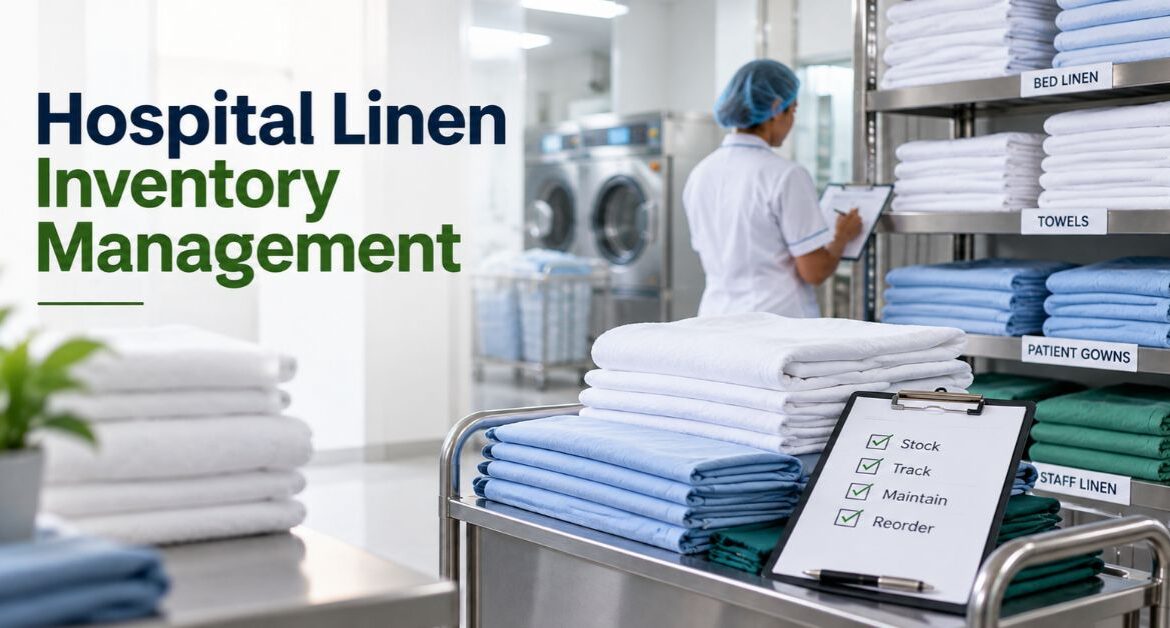
You ask a ward to order fresh bedsheets. But when you arrive at the linen store, you find almost nothing left on the shelves. Meanwhile, another department has piles in their cupboard, and no one can say how many clean sheets remain with the laundry.
Does the hospital need to order more linen? Probably. But first, it needs to figure out what happened to all this linen they already own.
Hospital linen inventory management spans purchasing, ward supply, laundry processing, and stock replenishment. When all these processes track the same accurate records, teams can anticipate replenishment and shortfalls before they become an everyday firefight.
Areas three healthcare teams and laundry businesses should pay special attention to are realistic par levels, transparent movement records, and consistent loss prevention. Read on for a step-by-step look at how these work together.
What Is Hospital Linen Inventory Management?
Hospital linen inventory management is the process of recording, distributing, recovering, and replenishing reusable hospital textiles. These might include bedsheets, pillowcases, blankets, towels, and patient gowns, with separate tracking sheets for specialty items.
Ideally, the inventory record can answer these four questions:
What do we own or control under a supply agreement?
Where is it now?
How much usable clean stock should be available?
What should be reordered, investigated, or replaced?
Tracking the total stock figure alone will not answer these questions. Linen awaiting rewash could still belong to the hospital, but it won’t fulfill a ward’s urgent request.
Inventory control is only one part of the end-to-end process we cover in LaundroMentor’s ultimate guide to hospital laundry management benefits.
Understanding Hospital Linen Par Levels
Put simply, a par level gives laundry teams an agreed-upon stock reference point. Some organizations will use the word “par” to mean something different, so each worksheet should define what their number represents.
According to the Association for Linen Management, one par is equal to the quantity used during 24 hours. They recommend adjusting levels when demand changes, but also if shortages or excess inventory occur. See their linen management toolkit for more.
For practical purposes, keep these three figures separate:
Stock figure
The running total; how many pieces the hospital linen inventory has or controls at any moment
Ward clean-stock target
How many usable clean pieces should be available to cover the anticipated replenishment interval, plus the chosen buffer
Total circulating pool
Pieces occupied by patients, in clean storage, awaiting collection, processing or transport
Replacement requirement
Pieces that should be ordered to cover confirmed retirements, losses or additions to services
If a hospital has enough linen in the total stock pool to meet par targets but still runs out on wards, something else is wrong. Supplies may not be evenly distributed, or they may not arrive on time.
Learn how to calculate each of these with steps below:
How to Calculate Hospital Linen Requirements
Measure Demand by Item and Department
Look at records from several weeks, including busy periods, weekends, and changing levels of occupancy.
Note clean pieces used, occupied bed- days, patient turnover rates, and the collection and delivery schedule. Changes to cupboard stock should be accounted for when using issue records to estimate usage. Receiving a large delivery may restore stock you counted as zero.
Calculate sheets, pillowcases, and patient gowns separately. When tracking procedure-driven departments like OR, FX, or maternity suites, consider using procedure counts instead of forcing every item into bed-day calculations.
Set the Clean-Stock Target
Scheduled replenishment system formula:
Ward clean- stock target = expected use until next reliable delivery + safety stock buffer
If orders take longer to arrive than planned, include that delay in the total number of days you need to cover. Ordering every day does not give you daily replenishment if it takes two days to deliver.
Returning to our hypothetical ward:
| Planning input | Example |
|---|---|
| Expected occupied beds | 40 |
| Observed linen use per occupied bed-day | 1.5 |
| Expected daily sheet demand | 40 sheets × 1.5 = 60 sheets |
| Replenishment coverage period | 1 day |
| Safety stock buffer | 20 sheets |
| Ward clean-stock target | 60 sheets + 20 buffer = 80 sheets |
Remember: the 1.5 usage rate is not a recommendation for linen-change frequency. Patients and caregivers decide when linen needs changing. Clinical guidelines determine linen use rates for required linen changes.
With 25 clean sheets available and zero outstanding deliveries, the next order would be 80 total target − 25 current stock = 55 sheets. Wait to subtract confirmed incoming stock until it arrives during the same planning period and has not already been included in the cupboard tally.
Target is not necessarily how much to order every cycle. Healthcare linen provider HandCraft has another good explanation of ordering up to the par target vs replenishing the difference between current stock and target. Read HandCraft’s par replenishment example.
Estimate the Total Circulating Pool
Now add linen that is not in clean storage. Continuing with our example:
If 80 sheets are in use on patient beds, and a two-day turnaround from use to clean delivery is typical, then about 60 x 2 = 120 sheets are “away” from clean storage during that portion of the cycle under normal demand.
Add those 120 sheets awaiting return to the 80-sheet clean target, and you have an example planning pool of:
80 clean + 120 pending return + 80 in use = 280 total sheets should always be in circulation
Items in each category should not overlap. For example, the safety buffer is already included in your clean-stock number; do not count it twice. Compare this estimate to known periods of peak demand, late deliveries, and any items regularly held for rewash or repair.
Plan Replacement Purchases Separately
Replacement is part of the linen inventory puzzle. Used linen will return from the laundry for reuse. Daily demand does not equal daily purchasing demand.
Replacement purchases should cover expected retirements and confirmed losses that occur during your procurement lead time. You may also wish to add approved capacity increases and a replacement reserve to that amount. Track purchase orders separately from clean laundry returns, so you don’t count the same linen twice.
Build A Hospital Linen Inventory Register
Create an item master that lists one code for every item type, size, and specification. Keep separate lists for hospital-owned linen and rental stock that belongs to the supplier.
For tracking movement through the inventory, use a movement register with minimum details from these fields:
| Field | Purpose |
|---|---|
| Date, time and transaction ID | Establishes a specific event that can be traced |
| Item code and quantity | Identifies what moved and how much |
| From and to locations | Specifies accountability at every handover point |
| Stock status | Separate clean items from in-use, soiled, processing, rewash, and retired statuses |
| Bag, cart or dispatch reference | Associates related movements (bulk counts) with each other |
| Issued and received by | Acknowledges who performed each step |
| Difference and follow-up | Keeps unresolved adjustments visible |
Bag numbers track the bag. They do not prove how many sheets were inside unless a reliable count was recorded with that bag number.
Ideally, use department codes and transaction descriptions for inventory management; patient names will not be necessary for this process.
Track Linen Through Each Handover
Establish a repeatable process for:
Receive clean linen: Incoming deliveries are logged and checked against the related paperwork. Observations are made about stock condition and cabinet space.
Issue to departments: Actual quantity issued and the destination are recorded.
Collect used linen: The container ID and collection time are recorded, using the hospital’s preferred linen handling procedures.
Confirm laundry receipt: When linen is returned from processing, the receipt is matched to the original collection ticket. Any discrepancies are flagged.
Record processing exceptions: Textiles headed for rewash, repair, or rejection are tracked separately and kept visible.
Return accepted clean stock: The return record is updated when clean linen is received back into storage. Availability is increased.
For outsourced services, agree who is responsible for counting at what points, where transfers happen, how turnaround time is measured, and how discrepancies will be managed before services begin.
Connecting Today’s Clean Delivery with Today’s Soiled Collection
Days do not always line up 1:1. Do not compare today’s clean linen delivery with today’s used linen collection, then assume the difference is loss. There may have been multiple bag numbers represented in each collection; they are likely from different batches of linen.
There may also be multiple deliveries destined for that department before the next use-collection cycle occurs.
Weight also cannot tell you how many pieces may be missing. Moisture content, topsoil, and variation in textile weights will skew your results.
Manual Records, Barcodes or RFID: Which Fits Your Operation?
Choose a linen tracking system that works for the events you need to record. These are a few common methods:
| Method | Capability | Limitation to consider |
|---|---|---|
| Register or spreadsheet | Record basic linen inventory movements without any specialized hardware. | Manual data entry must be carefully checked for accuracy. |
| Barcode system | Automatically identifies what moves when a labeled item, bag, or cart is scanned. | You can only track what is labeled. Additional reconciliations are required when manually collected linen is added to storage. |
| RFID system | Mass-identify tagged textiles passing through certain read points. | Integration with other software, missed reads, and tag damage will need to be monitored. |
Get familiar with different RFID workflows by reviewing LaundryTech’s examples for collection, processing, storage, and dispatch. The demonstrations show what may be possible with textile tagging and different reader placements, not limitations of every system.
Test your preferred technology with a small group of staff. See if they consistently understand how scans relate to the physical linen they handle. Can they successfully process linen that did not or could not get tagged? A last-read scan tells you where the equipment detected a tag; it cannot prove the item made it past another processing point.
How to Reduce Linen Loss in Hospitals
Look at the complete picture before ruling something lost.
Establish an agreed linen counting cut-off for all teams managing the store, wards, laundry or transport movements. Each item should only be counted once, in one location and status.
If the laundry expects to receive 500 pairs of socks today, those socks should not be counted again when the store adjusts its “on-hand” quantity.
For hospital-owned inventory, your formula may look like this:
Expected ending inventory = beginning inventory + new receipts + incoming transfers − outgoing transfers − approved retirements
Internal ward transfers and laundry shipments do not decrease total inventory.
Using the above example: If your opening pool was 1,000 bed sheets, you received 100 new sheets from your supplier, and approved 30 older sheets for retirement. With zero external transfers added or subtracted, you would expect to have 1,070 sheets in stock at day’s end.
If your physical count of every location only totals 1,040 sheets, there are currently 30 sheets missing. Find those sheets before accepting the loss as confirmed.
Make sure stock is always visible.
Hang labels on storage shelves and display bull’s-eye targets for each item. Give staff members an emergency reorder process if they start feeling the need to hide supplies from supervisors.
Patient activity may have increased, laundry deliveries may be arriving late, or perhaps the target number is too low. Meet with the ward supervisor to discuss repeat deviations from the target.
Loss is not retirement.
When damaged linen is removed from service, it should be for an approved reason. These reasons may include tearing, permanent staining, or an otherwise failed inspection process.
Remove the item from availability, record why it was removed, and who approved it. Then follow your facility’s procedures for supplier notifications.
Misplaced linen needs to be investigated. Faulty linen kept in circulation will hurt your inventory numbers more than hiding the problem helps.
Control Extra Movement and Misuse
Know who is allowed to take linen out of the facility, and why. Once it has been returned to clean storage, is that linen truly ready for patient use? Hospital housekeeping teams should have clean supplies dedicated to non-bedding tasks so bed linen doesn’t get diverted for floor washing or wiping equipment.
ALM provides resources on patient transfers as well as sample discard policies. Both topics can make for worthwhile discussions with your hospital client.
Inventory counts should never interfere with safe handling practices.
If linen handling procedures are not already dictated by infection prevention, review the CDC’s laundry guidelines. Inventory cut-off times should never put staff at risk of exposure to biohazardous waste or cause them to skip steps in approved cleaning procedures.
Whenever possible, have your hospital’s infection prevention team review counting locations, handling methods, and sanitization of staff involved in the process. Do not change handling procedures to make counting easier.
Sorting laundry by patient room number at the bedside is not recommended, even if it does improve your count. Shaking soiled linen to make it easier to count is also not recommended.
Similarly, you should not ask staff to dig through biomedical waste to find missing linen. Use separate waste containers and investigate any missing tagged laundry through a predetermined process. Inventory levels should enable linen changes as needed for clinical care, not prevent them.
Which Inventory Metrics Matter Most?
Try starting with a simplified dashboard that drives continuous improvement:
| Measure | Definition | What to investigate |
|---|---|---|
| Stockout incidents | Unfulfilled item requests by department and shift | Delivery timing, distribution and target levels |
| Request fill rate | Pieces supplied ÷ pieces requested for the same item and period × 100 | Recurring service gaps; do not combine unlike items |
| Laundry turnaround | Time from agreed collection point to accepted clean return | Delayed batches and processing bottlenecks |
| Unaccounted variance | Expected closing pieces minus verified pieces | Missing transactions, external holdings and possible loss |
| Retirement quantity | Approved pieces removed, by reason | Repeated damage patterns |
| Usage per occupied bed-day | Relevant inpatient pieces used ÷ occupied bed-days | Changes in workload or consumption |
Applies to inpatient linen only. Consult clinical partners when usage seems higher without evidence of waste.
A Realistic First Month Plan
Week 1: Document item types, ownership levels, and ideal storage areas. Confirm starting stock levels and responsibility for handovers.
Week 2: Track use rates and laundry turnaround times. Begin testing clean-stock targets with one ward only. Note any shortages or overages.
Week 3: Implement movement register, retirements approvals, and discrepancy follow-up log. Reconcile one picked-up/p returned cycle from your outsourced partner.
Week 4: Discuss the pilot experience with housekeeping, clinical, and laundry staff. Correct target inaccuracies, investigate recurring gaps, then prepare for a phased rollout.
Keep tracking data as needed. Some hospitals may require a few months of observations to factor in seasonal changes.
Conclusion
Effective hospital linen inventory control starts with visibility. Knowing what you have available, where it’s going, and when it truly leaves your operation allows you to set proper ward targets. Account for laundry turnaround time and make every transfer accountable with a signature or barcode scan.
If you’re reading this as a laundry owner preparing for your first healthcare accounts, take a look at LaundroMentor’s blog post about starting a laundry business. It covers how to organise your staff and prepare your overall operations.
Spend some time with the client’s housekeeping leadership and infection prevention staff to finish building this process. Gather reliable data from just one ward and one commonly used item until you’ve proved your sheet counts and targets are realistic. Then start improving.
Bonus Tip: Lost linen cannot always be calculated with RFID tags. Inventory shrinkage could be due to missing transaction records, lost on storage shelves, or even stored without individual tags.
Frequently Asked Questions
2. How many par levels should hospital linen have?
There is not a “one-size-fits-all” number suggested by this article for every linen department. Your linen par levels should be calculated from real demand, linen in-use, regular collection times, processing times, and realistic delivery performance. Plus a cushion for unknowns.
3. How do hospitals track linen without RFID?
Absolutely. You can manually track movement with just a register or spreadsheet. The more detailed and timely your records, the more useful the data will be. Missing transactions, piles kept on shelves, and unmarked laundry can hurt your accuracy.
4. How do you calculate linen loss in a hospital?
Begin by calculating what quantity of linen should be available to the hospital. Once you have that number, verify your count across all possible locations. The difference is missing linen that should be investigated before assuming it is confirmed loss.
5. How often should hospitals do linen inventory?
Acknowledging when supplies are low (running out) is part of linen inventory management. Auditing supplies for reconciliation purposes is another. Otherwise, count linen levels when you anticipate a refill, investigate discrepancies quickly, then verify linen on a regular schedule that makes sense for your hospital’s volume.

Aman Sawaran is a leading laundry business consultant who has personally guided over a hundred laundromat owners to success. With years of hands-on experience in the laundry industry, Aman specializes in helping entrepreneurs build and scale profitable laundromats and pick-up & delivery laundry businesses. His step-by-step consulting program covers everything from selecting the ideal distributor and perfect location to securing financing and launching a state-of-the-art laundromat within just 3 to 6 months. Ready to transform your laundry business idea into a thriving venture? Aman can show you how to launch, scale, and maximize your profits with proven strategies and expert guidance.


