

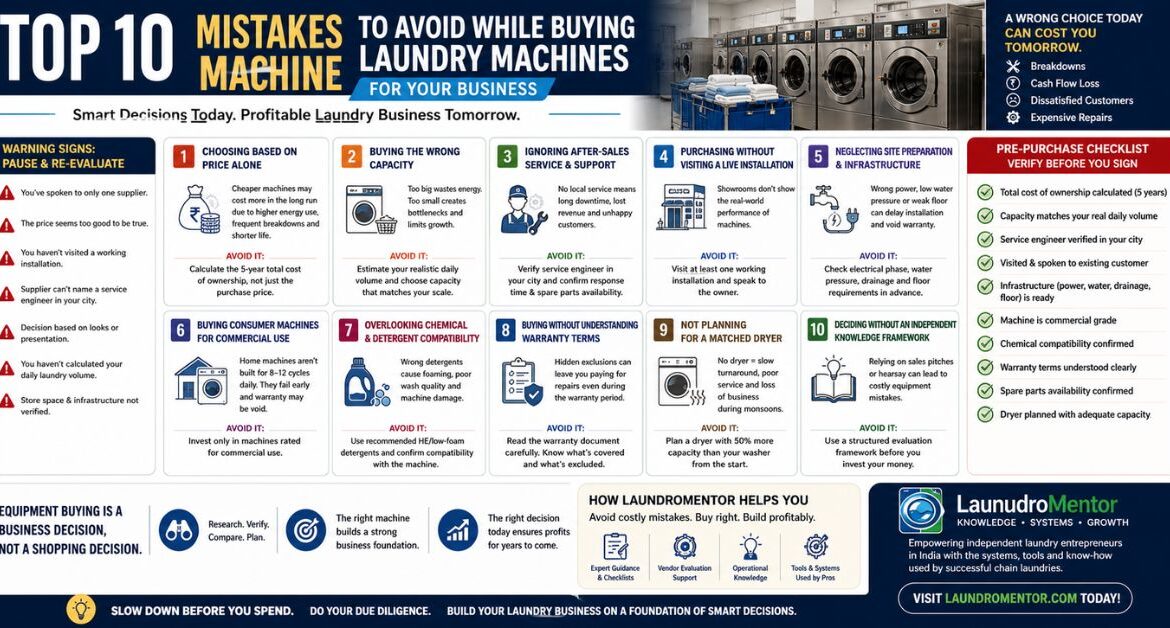
Purchasing laundry equipment is easily one of the most significant financial investments that a laundry entrepreneur will make. Do it correctly and your machines power a profitable, well-oiled laundry business. Do it incorrectly and you might find yourself with breakdowns, negative cash flow, dissatisfied customers, and one expensive lesson on how to run a laundry… backwards.
The irritating part is that these mistakes are completely preventable. They aren’t caused by poor luck or economic flux. They occur when first-time laundry business owners aren’t privy to the right information at the right time, BEFORE they sign that purchase order.
Below you’ll find a list of the 10 most common (and damaging) mistakes made when purchasing laundry equipment in India and how to avoid each pitfall. Whether this is your first store or you’re looking to expand an existing business, use this list to help you make a wise, informed equipment investment.
Why Laundry Equipment Buying Mistakes Are So Common in India
The laundry sector in India is booming, but it’s still in its nascent stages. You won’t find many associations or organisations supporting it the way you will find in more established markets such as the US or Europe. There are no standardised buying guides. Consultants who have launched and grown multiple laundromats are few and far between. Most laundry entrepreneurs buy their machines researching on their own, listening to supplier sales pitches, visiting online forums, or asking their friends who maybe set up shop a few years ago with different kinds of machines and for a completely different scale of business.
Couple this with a significant variance in the quality of machines available, brand reputation, and after sales support coverage in different cities in India, and you have a set up for terrible equipment purchasing decisions. Here are some we see happening time and again across new laundromats opening up in the country, whether in metros or tier-2 cities.
Warning Signs You Are About to Make a Costly Equipment Mistake
Before diving into each mistake in detail, here are the early warning signs that a purchasing decision is heading in the wrong direction. If any of these sound familiar, pause and re-evaluate before proceeding:
• You have spoken to only one supplier and are already feeling ready to buy.
• The price offered seems significantly lower than everything else you have seen — and you have not asked why.
• You have not visited a working installation of the machine you are considering purchasing.
• The supplier cannot name a service engineer based in your city.
• Your decision is based primarily on the machine’s appearance or the supplier’s presentation quality.
• You have not yet calculated how many kilograms of laundry you expect to process per day.
• Your store space has not been measured and verified against the machine’s dimensions and installation requirements.
The Top 10 Mistakes to Avoid When Buying Laundry Machines for Your Business
Mistake 1: Choosing Based on Purchase Price Alone
The mistake: This is the single most common error made by first-time laundry business owners. A machine priced at Rs. 1.5 lakh looks like a better deal than one priced at Rs. 3.5 lakh — until you account for the full picture.
The reality: Cheaper machines often mean greater energy use, shorter life expectancy, more expensive spare parts, poorer after-sales service. In many cases, the five-year cost of ownership on an inexpensive machine will cost more than a higher-end machine. Prior to purchasing any equipment determine the estimated five year cost of ownership. What you paid for the machine, installation cost, estimated monthly electric and water usage, anticipated maintenance costs each year and cost of lost opportunity when machine goes down.
Mistake 2: Buying the Wrong Capacity for Your Business Scale
The mistake: Entrepreneurs either overestimate their initial demand and buy machines that are too large — wasting electricity on half-empty cycles — or underestimate it and buy machines that create production bottlenecks within the first few months.
The reality: Capacity planning requires honest, data-driven projections — not optimistic assumptions. Before selecting a machine, estimate your realistic daily volume based on your location, target customer base, and planned operating hours. A reasonable starting point for a neighbourhood laundry store is 30 to 60 kg of laundry per day. From there, work backwards: a 15 kg machine running four cycles per hour at 60 percent utilisation handles roughly 36 kg per hour.
Mistake 3: Ignoring After-Sales Service and Local Support
The mistake: Buyers focus on the machine’s features and the supplier’s sales pitch, but rarely investigate what happens when the machine breaks down.
The reality: A laundry machine breakdown during your peak hours is not just a technical inconvenience it is a direct revenue loss and a customer experience failure. Before buying, confirm: Is there an authorised service engineer in your city? What is their typical response time? Are spare parts stocked locally or imported to order? Ask the supplier for the name and contact number of the nearest service engineer, then call that engineer independently and verify. Do not rely on the supplier’s word alone.
Mistake 4: Purchasing Without Visiting a Live Installation
The mistake: Buying a commercial washing machine based purely on brochures, YouTube videos, or a showroom demonstration that lasted thirty minutes.
The reality: Every machine looks impressive in a controlled demonstration. What you need to see is the machine operating under real business conditions — handling eight to twelve cycles a day, dealing with varied fabric loads, and managing the kind of operator handling that happens in an actual store. Ask the supplier for the contact details of three existing customers who have been using the machine for at least twelve months. Visit at least one of them.
Mistake 5: Neglecting Site Preparation and Infrastructure Requirements
The mistake: Finalising a machine without checking whether your store’s electrical system, water supply, drainage, and floor structure meet the machine’s installation requirements.
The reality: Commercial washing machines have specific infrastructure demands. Many require a three-phase electrical connection, which is not available in all commercial premises and may take weeks to obtain. Water inlet pressure must meet a minimum threshold; low pressure requires a booster pump, adding to cost. Hard-mount machines need anchor bolts drilled into a concrete floor; if your store is on an upper floor or has a tiled surface floor, this may not be possible without reinforcement.
Mistake 6: Buying a Consumer Machine for Commercial Use
The mistake: To save money upfront, some entrepreneurs purchase household-grade washing machines a standard 7 or 8 kg home appliance and use them for commercial operations.
The reality: Consumer washing machines are engineered for approximately one to two cycles per day. Running them through eight to twelve cycles daily will accelerate mechanical wear dramatically and cause failure within months. Additionally, the warranty on most consumer machines is explicitly void if used for commercial purposes. You will also find that consumer machines deliver inconsistent results with heavy or mixed commercial loads.
Mistake 7: Overlooking Chemical and Detergent Compatibility
The mistake: Assuming any commercial detergent or chemical will work with any commercial machine.
The reality: Modern commercial washing machines, particularly European brands, are calibrated for low-foaming, HE (High Efficiency) detergent formulations. Using conventional high-foam detergents causes excessive sudsing, which triggers automatic safety shutoffs and, over time, damages drum seals and bearings. Some machines also come with integrated chemical dosing systems that are designed to work with specific detergent types. Before purchasing a machine, confirm with the supplier which detergent types are compatible and budget for the correct chemicals as part of your operating cost plan.
Mistake 8: Buying Without Understanding the Warranty Terms
The mistake: Accepting the supplier’s verbal warranty promises without reading the written warranty document carefully.
The reality: Warranty documents contain exclusions that are rarely mentioned during the sales conversation. Common exclusions include: damage caused by voltage fluctuations, use of incompatible detergents, improper installation, water quality issues, and wear parts like belts, seals, and door gaskets. Some warranties cover parts but not labour, meaning you still pay for every service visit even within the warranty period.
Mistake 9: Not Planning for a Matched Dryer
The mistake: Budgeting only for the washing machine and treating the dryer as a secondary or optional purchase to be made later.
The reality: In Indian cities, particularly during the monsoon season, laundry without a commercial dryer is an operational bottleneck waiting to happen. Air-drying is unreliable, slow, and creates a poor customer experience. Your dryer capacity should be planned as part of the same equipment budget as your washer not as an afterthought. A practical guideline is to have dryer capacity approximately 50 percent higher than washer capacity to account for expanded wet laundry volume.
Mistake 10: Making the Decision Without an Independent Knowledge Framework
The mistake: Relying entirely on the supplier’s advice, a friend’s recommendation, or a single online review to make a multi-lakh rupee equipment decision.
The reality: Every source of advice has its own bias. Suppliers want to sell. Friends may have bought machines for a completely different business context. Online reviews are often written by consumers, not commercial operators. What you need is a structured, independent framework for evaluating machines — one that accounts for your specific business model, location, customer segment, and financial position.
How LaundroMentor Helps You Avoid These Mistakes Before They Happen
All ten of these mistakes come down to one thing: missing information. When buying their first industrial laundry equipment, new laundry owners in India don’t have access to the historical knowledge of seasoned operators. Knowledge like: what questions to ask, what things to verify, and what warning signs to look for before signing on the dotted line for a major equipment purchase.
We built LaundroMentor to fill that knowledge gap for independent laundry owners throughout India. LaundroMentor isn’t a franchise system. You own 100% of your business. LaundroMentor just gives you access to the playbook that franchisors and professional laundry chains use. We provide the operational knowledge, tools, and systems used internally at successful chain laundries right to you, the small, unorganised storefront owner building your business from the ground up.
If you’re at the stage of looking to buy equipment, information like this is truly powerful. Instead of walking into a dealer’s showroom blind, you walk in with a checklist. You know exactly what needs to be evaluated, what questions to ask, and what warning signs to look out for. The result? You make a smart purchase that you’ll be proud of for years to come, not one you’ll regret tomorrow.
Pre-Purchase Checklist: What to Verify Before Signing Any Equipment Agreement
Use this checklist before committing to any laundry machine purchase. If you cannot answer all of these questions with confidence, do more research before proceeding:
• Total Cost of Ownership: Have you calculated the estimated five-year cost including purchase, installation, utilities, maintenance, and downtime?
• Capacity Fit: Does the machine’s rated capacity match your realistic daily volume projection — not your optimistic one?
• Service Verification: Have you independently verified that an authorised service engineer is based in your city and confirmed their average response time?
• Reference Visit: Have you visited at least one business that has been using this machine for twelve or more months and spoken to the owner directly?
• Infrastructure Readiness: Have you confirmed your store has the required electrical phase, water pressure, drainage position, and floor type for this machine?
• Machine Grade: Is the machine rated for commercial use — not a consumer or semi-commercial appliance?
• Chemical Compatibility: Have you confirmed which detergent types are compatible with this machine and factored the correct chemicals into your operating cost plan?
The Broader Lesson: Equipment Buying Is a Business Decision, Not a Shopping Decision
Each of the ten laundry equipment buying mistakes listed above is related to one core mistake: approaching the purchase of commercial laundry equipment as if you’re buying a washing machine for your home. When you buy something as a consumer, you think about features, price and how the brand makes you feel. When you buy business equipment, you should think about how it fits with your operation, the cost of ownership over time and service and how reliable the machine is at scaling with your business as it grows.
The operators who run the most profitable laundry businesses aren’t always the ones who spend the most money or buy the most expensive equipment. They’re the ones who understand their business model and purchase equipment that fits it. They know their operational needs before they step foot in a vendor’s showroom and buy with their heads rather than their hearts.
If you’re still in the planning stages of launching your laundry and want to evaluate your equipment options (as well as every other decision you’ll make) with that level of thoughtfulness, check out LaundroMentor.
Conclusion: Slow Down Before You Spend
None of the errors we’re discussing here are unpreventable. Each one can be avoided with a little diligence. You don’t need technical expertise to avoid these pitfalls, you just need to take the time to ask the correct questions, perform the necessary due diligence, and understand all the ramifications of your choices before making a decision.
The laundry sector in India is a fantastic business opportunity. Interest from entrepreneurs and investors continues to rise. In most areas of India, competition is still light. And finally, the barriers to entry are fairly low. But if you want to own a profitable laundry, you need to start with the proper equipment. That means knowing why you need specific equipment, having it installed in a prepared room, and having access to quality service technicians when you need them. Spend the time to do this right, and everything you do from there will be on solid ground.
Frequently Asked Questions
Can I use a regular home washing machine when starting a small laundry business to save money?
This is not recommended for a commercial setup. Consumer washing machines are designed for one to two cycles per day and will fail quickly under the eight to twelve daily cycles typical of even a small laundry store. Most consumer machine warranties are explicitly void when used commercially, leaving you with no recourse when breakdowns occur.
How do I verify whether a laundry machine supplier's after-sales service claims are accurate?
The most reliable method is independent verification. Ask the supplier for the direct contact details of their service engineer in your city — not the head office service number, but the local engineer. Call that engineer independently and ask: How long does it typically take to respond to a call in this city?
What infrastructure should I prepare before my commercial washing machine is delivered?
Before delivery, confirm and prepare: the correct electrical phase connection (single or three-phase as required by the machine), adequate water inlet pressure with a booster pump if needed, a properly positioned drainage outlet, floor reinforcement or anchor bolt capacity for hard-mount machines, and adequate ventilation for heat dissipation. Measure the machine's dimensions against your door clearances and planned installation space, including the door swing radius. Addressing these requirements before delivery avoids costly delays and rework.
How can LaundroMentor help me make better laundry equipment decisions?
LaundroMentor provides independent, structured guidance for laundry entrepreneurs in India across all stages of business setup, including equipment selection. It is not affiliated with any machine brand or supplier, so the guidance is objective. Through the frameworks and systems it provides, entrepreneurs can approach supplier conversations with the right questions, evaluate machines against consistent criteria, and avoid the most common and costly purchasing mistakes.

Aman Sawaran is a leading laundry business consultant who has personally guided over a hundred laundromat owners to success. With years of hands-on experience in the laundry industry, Aman specializes in helping entrepreneurs build and scale profitable laundromats and pick-up & delivery laundry businesses. His step-by-step consulting program covers everything from selecting the ideal distributor and perfect location to securing financing and launching a state-of-the-art laundromat within just 3 to 6 months. Ready to transform your laundry business idea into a thriving venture? Aman can show you how to launch, scale, and maximize your profits with proven strategies and expert guidance.


