

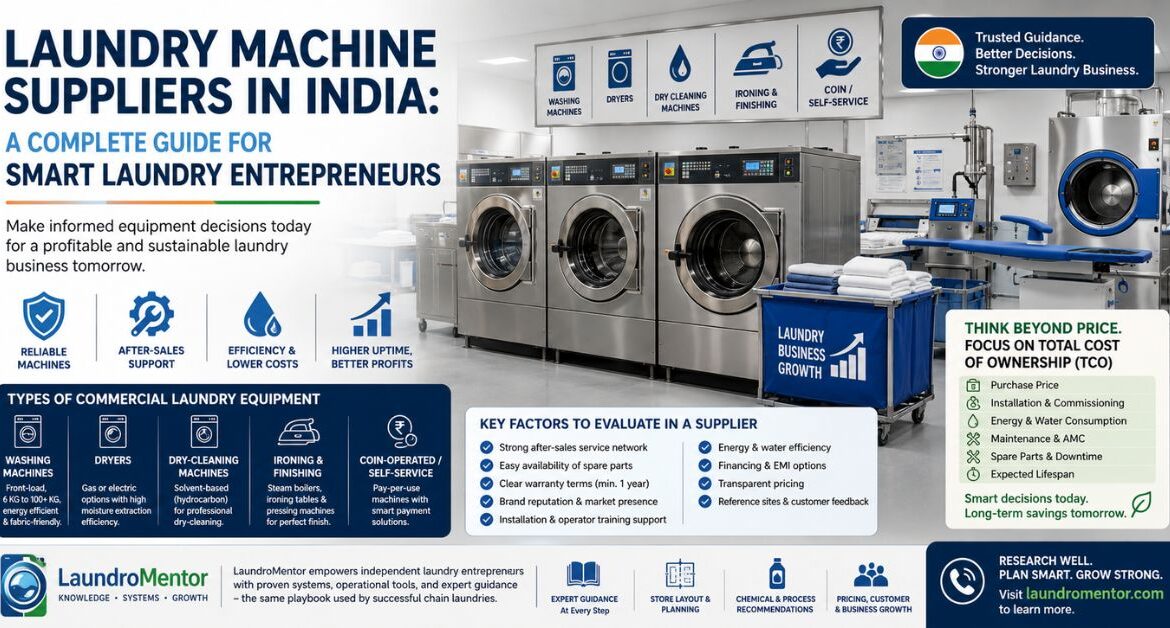
Professional laundry services in India are booming. Urbanization, rising disposable incomes, and evolving lifestyle needs mean entrepreneurs have never had more opportunity in this space. Whether you want to start a local laundry, semi-commercial laundromat, or large-scale dry-cleaning business, your biggest purchase will be your laundry machines (and by extension, your laundry machine supplier).
In this guide, we’ll cover everything you need to know about finding laundry machine suppliers in India. You’ll learn who the top suppliers are, what to look for in a supplier, how to avoid the biggest pitfalls when you’re buying laundry machines for the first time, and more. By the end, you should have a checklist you can use to make the best decision for your business.
Why Choosing the Right Laundry Machine Supplier Matters
I’ve seen laundry entrepreneurs obsess over location, prices or branding but completely ignore where they purchase their equipment from. Your laundry machine supplier becomes your business partner for years to come. They affect your uptime, service experience, maintenance expenses and bottom line.
Let me break down the Indian laundry equipment market for you. You have imported European and Korean brands, machines made in India and refurbished units. Prices range from very cheap to expensive. Keep in mind that after-sales service is where most consumers realize they’ve been had. A cheap machine can end up costing you much more if spare parts are difficult to find or if service engineers are hours away from your city.
Types of Laundry Machines Available in India
Before approaching any supplier, it helps to understand the different categories of commercial laundry equipment available in the Indian market:
1. Front-Load Commercial Washing Machines
These are the workhorses of any professional laundry setup. Available in capacities ranging from 6 kg to 100+ kg, commercial front-loaders are energy-efficient, gentler on fabric, and designed for continuous operation. Brands like Electrolux, LG Commercial, Miele, and Alliance Laundry are well-regarded in this segment.
2. Commercial Dryers
Tumble dryers are essential for high-volume laundry operations, especially in monsoon-prone regions. Gas dryers are generally more cost-efficient in the long run, while electric dryers are easier to install. Buyers should pay attention to moisture extraction efficiency and drum capacity alignment with their washer.
3. Dry-Cleaning Machines (Solvent-Based)
Dry-cleaning machines use chemical solvents instead of water. Hydrocarbon-based machines have largely replaced older PERC-based units in India due to environmental regulations. These are typically costlier and require trained operators, making supplier after-sales training especially important.
4. Steam Ironing and Finishing Equipment
Steam boilers, ironing tables, and pressing machines complete the laundry workflow. Many suppliers bundle these with washing equipment or recommend compatible finishing units. Quality finishing equipment directly impacts customer satisfaction.
5. Coin-Operated / Self-Service Machines
A growing segment in Indian cities, coin-operated machines allow customers to wash their own clothes at a pay-per-use rate. These require minimal staff and are popular in hostels, apartment complexes, and co-living spaces. Suppliers for this segment also often provide software-based coin or card payment management systems.
Key Factors to Evaluate When Choosing a Laundry Machine Supplier in India
Not all suppliers are created equal. Here are the most critical factors to assess before making a purchase decision:
• After-Sales Service Network: Confirm that the supplier has authorised service engineers in your city or region. Ask specifically how many service calls they handle per month and what their average response time is. A machine breakdown during peak business hours can be extremely costly.
• Spare Parts Availability: Check whether common spare parts — bearings, belts, heating elements, valves — are stocked locally or need to be imported. Import-dependent parts can mean weeks of downtime.
• Machine Warranty Terms: A standard commercial machine should carry a minimum 1-year comprehensive warranty. Be cautious of warranties that exclude labour or specific components. Always read the fine print.
• Brand Reputation and Longevity: Opt for brands that have been operating in India for at least 5 to 10 years. Established brands have better service infrastructure, trained technicians, and proven machine reliability records.
• Installation and Training Support: Good suppliers offer installation support and initial operator training. If a supplier is unwilling to conduct even a basic demo before purchase, consider that a red flag.
• Energy and Water Efficiency Ratings: Utility costs form a major portion of laundry operating expenses. Ask for energy consumption data (kWh per cycle) and water usage (litres per kg of laundry) and compare across suppliers.
• Financing and EMI Options: Some suppliers work with NBFCs or leasing companies to offer equipment financing. This can ease the capital burden for new business owners, though you should always calculate the total cost of ownership before committing.
Major Laundry Machine Suppliers Operating in India
India has a mix of international brands with local distributors and homegrown manufacturers. Here is a broad overview of the landscape:
International Brands with India Distribution
Brands like Electrolux Professional, Miele Professional, Primus, Speed Queen, and Girbau have established dealer networks across major Indian cities including Mumbai, Delhi, Bengaluru, Chennai, Hyderabad, and Pune. These machines are generally at the premium end of the price spectrum but come with superior build quality, longer lifespans, and better energy ratings.
Indian Manufacturers
Several Indian companies manufacture commercial laundry equipment suited for the local market. These machines are priced more competitively and spare parts are easier to source domestically. While quality has improved significantly over the past decade, buyers should request references from existing customers and verify machine performance data independently.
Refurbished Equipment Suppliers
For those starting on a tight budget, refurbished machines from reputable dealers can be a viable option. However, exercise caution: always inspect the machine in person, ask for its service history, and insist on a minimum 3-month warranty. Unverified refurbished machines from unorganised dealers have cost many new business owners dearly.
How LaundroMentor Helps You Navigate the Laundry Equipment Market
Knowledge deficiency is often cited as one of the biggest hurdles new laundry entrepreneurs face. Manufacturers’ sales teams will (of course) promote their own products. And online information can be sketchy or dated at best. That’s why an objective, organized system of guidance can be so helpful.
LaundroMentor exists to fill this void. We are not a franchise. We don’t attempt to brand you or make you part of a chain. Instead LaundroMentor arms small, independent laundry owners with the same systems, knowledge base and operating tools that are used behind the scenes at chain laundries everywhere. It’s like a peek under the hood of professional laundry…then taking that knowledge and making it available to you, wherever you are in India.
Need help with what machines to buy? How to lay out your store? Which chemicals to use? How to manage customers? How to price your services? LaundroMentor has you covered with organized systems to help you make informed decisions, not expensive ones. If you’re researching Indian washing machine suppliers, it really helps to have an objective sounding board. You could end up with a machine that helps run your business for the next 10 years…or you could end up making lots of mistakes.
Common Mistakes to Avoid When Buying Laundry Equipment in India
Even experienced businesspeople make avoidable errors when entering the laundry industry for the first time. Here are the most frequently observed mistakes:
• Buying based on price alone: The cheapest machine available is rarely the most cost-effective over a 5-year horizon. Factor in energy costs, maintenance frequency, and expected lifespan.
• Ignoring capacity planning: Buying a machine that is too small for projected demand leads to backlogs and customer dissatisfaction. Buying one that is too large wastes utility costs on half-loaded cycles.
• Skipping site preparation: Commercial machines have specific requirements for water pressure, drainage, electrical load, and floor reinforcement. Neglecting these can void warranties and cause premature machine failure.
• Not verifying the local service network: A supplier may claim national coverage but have no actual service presence in your city. Always ask for the contact details of service engineers in your area and verify independently.
• Overlooking chemical compatibility: Commercial machines are often calibrated for specific detergent types and dosing systems. Using incompatible chemicals can damage the machine and affect wash quality.
• Skipping the demo: Always insist on a live demonstration — either at the supplier’s facility or at a reference installation. Seeing a machine in operation tells you far more than a brochure ever will.
Understanding the Total Cost of Ownership (TCO)
Do NOT compare suppliers based on purchase price alone. Work out the Total Cost of Ownership (TCO) over a 5-year period. Total cost of ownership includes purchase price; installation/commissioning charges; average monthly electricity and water usage charges; AMC charges; expected costs of spare parts replacements; estimated downtime costs (which you can work out from reliability data of the machine).
A Rs. 3 lakh machine which guzzles energy and is trouble-prone will typically end up costing more than a Rs. 5 lakh efficient machine which runs without much maintenance over a 5-year period. Thinking in terms of TCO is what differentiates smart laundry entrepreneurs from those who go kaput in Year 2 or Year 3.
Questions to Ask Laundry Machine Suppliers Before You Buy
Equip yourself with the right questions before meeting any supplier. A well-prepared buyer is much harder to oversell to, and credible suppliers respect buyers who do their homework.
- How many machines of this model have you sold in India, and can you share customer references in my city?
- What is the average number of cycles per day this machine is designed to handle continuously?
- What is your response time for a service call, and do you have engineers based in my city?
- Are spare parts for this model available in India, or do they need to be imported?
- What does the warranty cover, and what are the exclusions?
- Do you offer an Annual Maintenance Contract (AMC), and what is the pricing?
- Can you provide the energy consumption data per cycle in kWh and water usage per kg?
Building a Sustainable Laundry Business Beyond Just the Machine
Choosing the correct machine is important, but only part of the equation. You also need defined service rates, effective workflows, trained staff, detergent & chemical programs that ensure consistent quality, and a plan to retain your customers.
India’s laundry industry is still widely unorganised. And that’s not a disadvantage for you – it’s an advantage. Simply by applying professional systems to your store (even if it’s small) you will prosper far beyond your neighbours who run their businesses blindly. That philosophy is embedded in LaundroMentor. We want to provide independent store owners in India the same operating playbook used by successful chain laundries. Without needing to pay franchise fees or relinquish ownership of their businesses.
If you’re just starting out in your research for suppliers and equipment, spend some time on laundromentor. It will help you see the larger picture of what you need to decide – beyond just which machine to purchase.
Conclusion: Make an Informed Equipment Decision
India’s laundry industry is at a tipping point. Entrepreneurs who approach the market with the right information, the right machines, and the right systems in place are the ones who will build long-lasting, profitable businesses. If you approach it strategically, the market for laundry machine suppliers in India is vast, competitive, and yes, even confusing, but it can be navigated.
Do your homework on suppliers. Factor in total cost of ownership (not just sticker price). Ask tough questions. Visit reference sites. And make sure you have your operations plan totally flushed out before those machines are delivered. Whatever time and effort you invest in research now will benefit you for years to come.
Frequently Asked Questions
Which capacity washing machine is best for a small laundry store in India?
For a small laundry store catering to residential customers in an urban neighbourhood, a 10 to 20 kg commercial front-load washer is typically a good starting point. It offers enough throughput for moderate daily volumes without excessive utility consumption. As your customer base grows, you can add a second machine rather than investing in an oversized unit upfront that runs mostly empty.
Is it better to buy or lease laundry machines for a new business?
Both options have merit depending on your financial position. Buying outright gives you full ownership and no monthly obligations, but requires higher upfront capital. Leasing or financing through an EMI arrangement preserves working capital and allows you to start operations faster. However, the total outflow over a lease term is generally higher than the purchase price.
How do I verify the after-sales service quality of a laundry machine supplier?
The most reliable method is to speak directly with existing customers in your city who use the same supplier. Ask about their experience with service response times, parts availability, and resolution quality. You can also ask the supplier for the contact details of their nearest service engineer and independently verify that the engineer is indeed active and local.
Can LaundroMentor help me select the right laundry machine supplier?
Yes. LaundroMentor provides independent guidance to laundry entrepreneurs across India. Rather than recommending a specific brand (since it is not affiliated with any equipment supplier), it equips you with a structured framework for evaluating machines, comparing suppliers, and making decisions based on your specific location, target market, and budget.

Aman Sawaran is a leading laundry business consultant who has personally guided over a hundred laundromat owners to success. With years of hands-on experience in the laundry industry, Aman specializes in helping entrepreneurs build and scale profitable laundromats and pick-up & delivery laundry businesses. His step-by-step consulting program covers everything from selecting the ideal distributor and perfect location to securing financing and launching a state-of-the-art laundromat within just 3 to 6 months. Ready to transform your laundry business idea into a thriving venture? Aman can show you how to launch, scale, and maximize your profits with proven strategies and expert guidance.


