

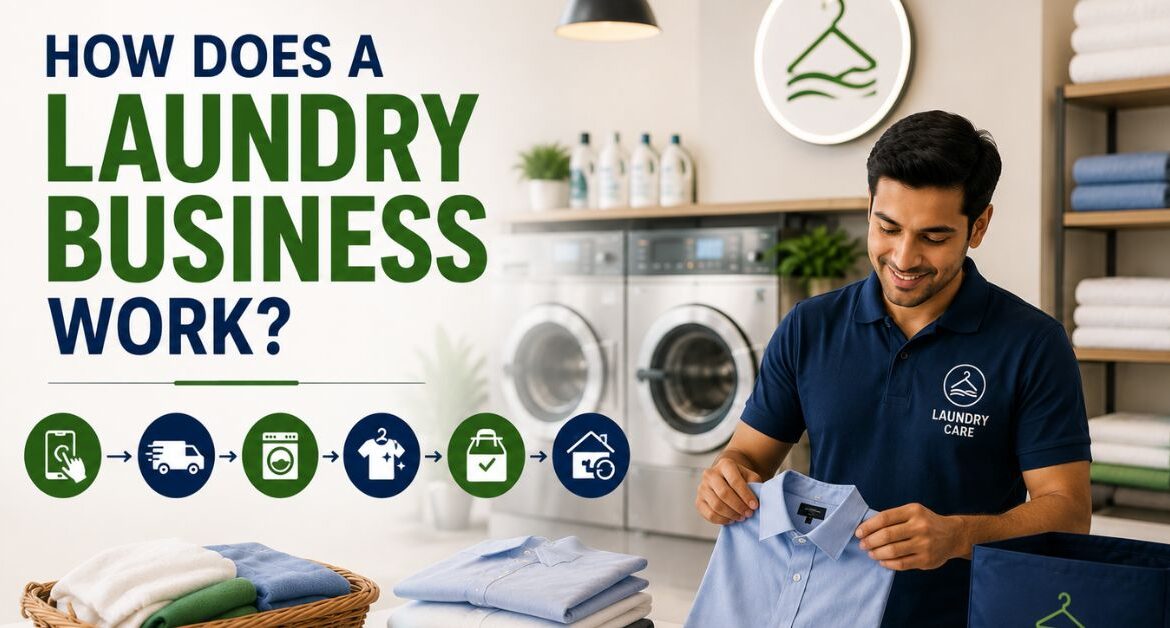
When we deal with laundry, we are customers. We take our bag of clothes there and collect the same after 1 or 2 days, ironed and folded neatly. But have you ever thought about the process that takes place behind the scene? It’s not as simple as you might think. There is a sorted process of operations like sorting clothes, operating machinery, quality checks, calculations of rates and many other logistics involved. If you are planning to jump into this business, you would first want to know – How does a laundry business work? And we have got you covered. Before you spend a single rupee, this is what you need to know about the journey of your clothes.
A laundry unit operates in the following manner. This step-by-step guide will talk about service models, daily operational workflows, machinery used and how a laundry makes money by offering this service.
The Core Service Models in the Laundry Industry
Not all laundry businesses operate the same way. Before understanding the workflow, it helps to know the different formats this business can take:
- Wash-and-fold laundromats — Customers drop off clothes by weight; the business washes, dries, and folds them for pickup.
- Dry cleaning outlets — Specialized cleaning for delicate fabrics, suits, sarees, and garments that can’t be machine-washed.
- Self-service laundromats — Customers use coin- or app-operated machines themselves, and the business earns from machine usage rather than labor.
- Pickup-and-delivery services — Orders are collected from the customer’s doorstep, processed at a central facility, and delivered back — popular in urban apartment complexes.
- B2B laundry services — Bulk contracts with hotels, hospitals, gyms, salons, and hostels requiring large-volume, recurring laundry processing.
Many successful laundry businesses today don’t pick just one model, they combine two or three of these to diversify revenue and reduce dependency on a single customer segment.
The Step-by-Step Workflow of a Laundry Business
Regardless of the service model, most laundry operations follow a fairly consistent operational sequence:
1. Order Intake
This is where a customer’s garments enter the system — either through a walk-in counter, a pickup request, or a B2B contract drop-off. At this stage, staff typically log the order, note special instructions (stains, delicate fabrics, starching preferences), and generate a receipt or digital order ID.
2. Sorting and Tagging
Garments are sorted by fabric type, color, and cleaning method required. Tagging each item (often with a barcode or numbered tag) ensures nothing gets mixed up between multiple customer orders — a step that’s especially critical in high-volume operations.
3. Washing/Cleaning Process
Depending on the garment, this stage involves:
- Machine washing with appropriate detergent and water temperature settings
- Dry cleaning using solvent-based cleaning for delicate or non-washable fabrics
- Stain treatment for specific marks before the main wash cycle
- Specialized handling for items like curtains, blankets, or leather
4. Drying
Industrial dryers handle bulk loads efficiently, but timing matters — over-drying damages fabric quality, while under-drying leads to musty odors and customer complaints.
5. Ironing/Pressing
This step significantly affects perceived quality. Many customers judge a laundry service primarily by how well-pressed and wrinkle-free their clothes look, making this one of the most quality-sensitive stages in the entire process.
6. Quality Check
Before packaging, a final inspection ensures no stains remain, buttons and zippers are intact, and garments meet the expected finish.
7. Packaging and Delivery
Clean garments are folded, hung, or packed based on order type, then either handed back at the counter or delivered to the customer’s doorstep.
What Equipment a Laundry Business Actually Needs
The scale of equipment depends on order volume and service type, but most functioning laundry setups require:
- Commercial-grade washing machines (higher capacity and faster cycles than domestic machines)
- Industrial dryers built for continuous, high-volume use
- Dry-cleaning machines for solvent-based cleaning (if offering that service)
- Steam presses or ironing stations for finishing
- Garment tagging and tracking systems (barcode scanners or basic software)
- Packaging materials — hangers, poly covers, and labeled bags
Underinvesting in commercial-grade equipment is one of the most common early mistakes — domestic machines simply can’t handle sustained daily volume without frequent breakdowns.
How a Laundry Business Actually Makes Money
The revenue model in laundry businesses is more layered than it looks from the outside. Income typically comes from a mix of the following:
- Per-kg or per-piece pricing for standard wash-and-fold services
- Premium pricing for dry cleaning and delicate garment care
- Subscription plans for regular household customers, offering predictable monthly income
- Bulk B2B contracts with hotels, salons, and hostels, which usually carry lower per-unit pricing but much higher volume
- Add-on services like same-day delivery, stain removal, or fabric softening at extra cost
The businesses that build steady, scalable revenue are usually the ones that don’t rely on a single pricing stream — a mix of subscription customers and bulk contracts creates far more predictable cash flow than depending purely on walk-in orders.
Where Most New Laundry Businesses Struggle Operationally
Even with a clear workflow on paper, execution often breaks down in specific, recurring ways:
- Inconsistent process standardization, where quality varies depending on which staff member handles an order
- Poor order tracking, leading to lost or mismatched garments between customers
- Inefficient machine scheduling, causing bottlenecks during peak hours and idle capacity during slow periods
- Underpricing services without accounting for water, electricity, and labor costs per load
- No structured customer retention system, resulting in heavy dependence on one-time or irregular orders
These operational gaps are often the real difference between laundry businesses that struggle to stay afloat and those that scale into multi-location operations.
Why Structured Systems Matter More Than Equipment Alone
The biggest lie told to aspiring Laundry owners is that all they need to do is purchase good equipment, to succeed. Operations; how to track orders, standardized operations, pricing logic and training employees, is equally important to success than the machines you run. Most “mom and pop” laundries have the same equipment as your corporate washeries. It’s the standardized operating procedures that allow scalable quality and cost controls.
LaundroMentor wants to bridge that gap. We’re not a franchise. LaundroMentor is a step-by-step mentoring program for the person or small store owner who desires to grow or professionalize their laundry business with proven systems, workflows, and proprietary knowledge used by successful laundry chains across the country. If you’ve ever wondered how to organize your intake sheet, properly price your services or where to even place quality-control checkpoints. Mentoring can significantly decrease the operational unknowns that most new laundry business owners encounter.
Turning an Unorganized Setup Into a Structured Business
For small and unorganized laundry store owners already running an informal setup, transitioning to a more structured model typically involves:
- Documenting a standard operating procedure for each stage, intake, sorting, washing, and delivery
- Introducing a basic tagging or tracking system to eliminate order mix-ups
- Training staff on consistent quality benchmarks rather than individual habits
- Reviewing pricing against actual cost-per-load rather than competitor guesswork
- Building a simple digital presence so customers can find and book services online
This transition from informal operation to systemized business is exactly where guided support becomes valuable. Programs like LaundroMentor exist to help small and unorganized store-owners across India adopt the same systems, tools, and structured knowledge typically reserved for larger, organized laundry chains, without requiring a franchise investment.
Final Thoughts
A laundry business isn’t just about washing and drying clothes, it’s a workflow-driven operation where sorting accuracy, machine efficiency, quality control, and pricing structure all determine whether the business runs smoothly or constantly firefights operational issues. Understanding this process end-to-end is what separates a laundry setup that merely functions from one that scales profitably.
For those looking to build or upgrade their laundry business with a proven operational framework rather than trial-and-error, resources like LaundroMentor offer exactly that kind of structured guidance, helping small laundry setups run with the same discipline and consistency as larger, organized players.
Frequently Asked Questions
What equipment is essential to start a laundry business?
Commercial-grade washing machines, industrial dryers, steam presses for finishing, and a basic order-tracking system are essential; dry-cleaning machines are needed only if offering that specific service.
How does a laundry business generate revenue?
Revenue typically comes from per-kg or per-piece pricing, premium dry-cleaning charges, subscription plans for regular customers, and bulk B2B contracts with hotels, salons, or hostels.
What's the difference between a laundromat and a dry-cleaning business?
A laundromat primarily handles machine-washable garments through wash-and-fold or self-service models, while dry cleaning uses solvent-based cleaning for delicate fabrics that can't be machine-washed.
Why do some laundry businesses struggle despite having good equipment?
Struggles usually stem from inconsistent processes, poor order tracking, inefficient machine scheduling, and underpricing services rather than equipment quality alone.

Aman Sawaran is a leading laundry business consultant who has personally guided over a hundred laundromat owners to success. With years of hands-on experience in the laundry industry, Aman specializes in helping entrepreneurs build and scale profitable laundromats and pick-up & delivery laundry businesses. His step-by-step consulting program covers everything from selecting the ideal distributor and perfect location to securing financing and launching a state-of-the-art laundromat within just 3 to 6 months. Ready to transform your laundry business idea into a thriving venture? Aman can show you how to launch, scale, and maximize your profits with proven strategies and expert guidance.


