

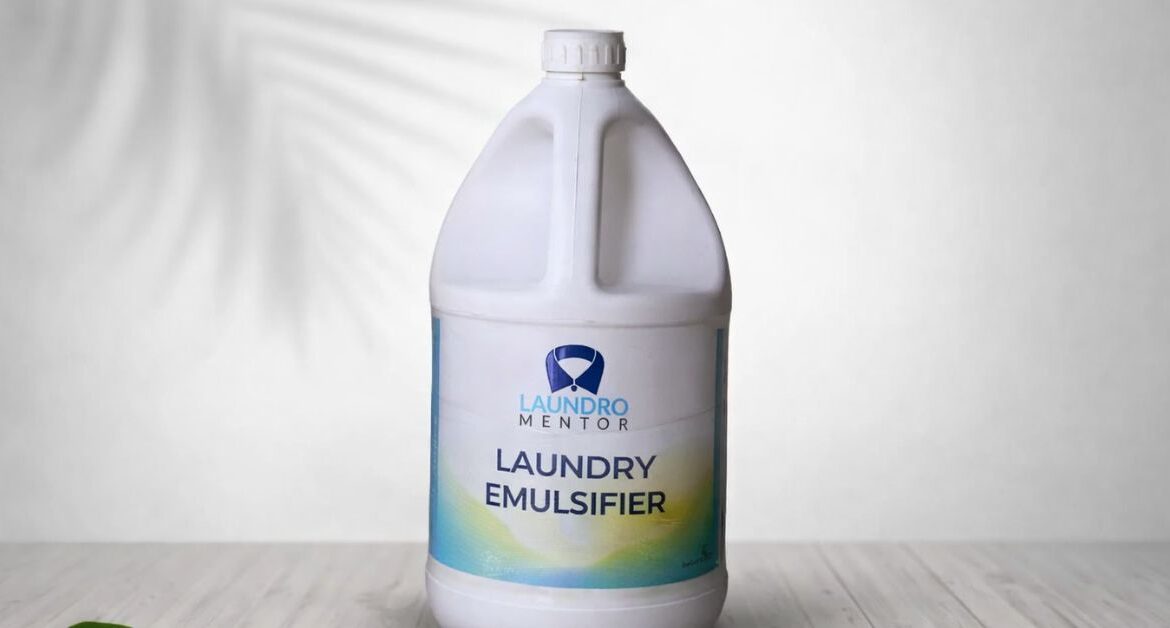
Visit a busy commercial laundry, hotel linen department, restaurant uniform facility or industrial workwear unit and you are guaranteed to find a bottle or drum of laundry emulsifier sitting on a shelf somewhere. And yet for the small laundry owner/operator this product is probably one of the most misunderstood chemicals they use in their business. They know it “works on” oily stains but often how and when is something of a mystery.
Let this guide break down the science of laundry emulsifiers into easily understandable terms, show you EXACTLY how they attack oil and grease stains at the molecular level and instruct you on when you should and should not use them as part of a complete commercial laundry dosing program.
What Is a Laundry Emulsifier?
A laundry emulsifier is a specialty pre-treatment or in-wash chemical formulated to emulsify and keep oil/fat/grease soils separated so they can then be removed by detergent and water. To emulsify something is to take a substance that would not normally blend with water and force it to be dispersed in water.
Water alone will not touch a grease stain during normal laundering. Oil is made up of non-polar molecules. Water is made up of polar molecules. Non-polar and polar won’t mingle; they are like chemical enemies. Since water is polar, and oil is not, water will simply bead up and roll off of oil. Just running something greasy under the tap will do nothing to it.
Enter the emulsifier. An emulsifier has molecules that are attracted to oil and water. One end of the molecule is hydrophilic (water attracting) while the other end is lipophilic (oil attracting). The lipophilic end lodges itself into the grease droplet, but the hydrophilic end of the molecule keepsPointing out toward the water. Eventually the grease is surrounded by emulsifier molecules forming a structure known as a micelle. Once this happens, that oily micelle is soluble in water.
How Emulsifiers Differ From Regular Detergents
Soap helps lift oils and greases from fabrics. Regular laundry detergent also contains surfactants which provide a degree of emulsification. So what’s the point of a separate emulsifier?
It’s all down to concentration and specificity. A general detergent has to deal with every type of soil imaginable – proteins, starches, dyes, mineral soils etc. so its cleaning power is diluted across many different ingredients. An industrial strength laundry emulsifier will be loaded with surfactants, solvents and penetrating agents specifically targeted at breaking down oily soils.
If your washing is heavily soiled with oils and greases (think industrial uniforms, kitchen staff uniforms, chef whites or garage overalls) you just won’t get enough emulsifying power from regular detergent in a single wash.
Professional grade emulsifiers also tend to work well at lower temperatures, which is another bonus as energy prices go up and more eco friendly washing regimes are adopted.
Types of Oil & Grease Stains That Emulsifiers Target
Common Lipid Based Stains in Commercial Laundry
Cooking oils and fats
Olive oil, butter, ghee, and deep fry oils on kitchen and restaurant linen.
Motor oil and lubricants
Machinery grease, hydraulic fluid, and engine oil on workwear.
Sebum and body oils
Natural skin oils that accumulate around collar and cuff areas over time, causing yellowing.
Cosmetic and skincare products
Foundation, sunscreen, hair products, and moisturizer residue on towels and spa linen.
Industrial cutting fluids
Metalworking lubricants and drilling oils on factory uniforms.
Food based fats
Butter, paneer oil, curries with fat content, particularly relevant in Indian hospitality laundry.
How a Laundry Emulsifier Works Step by Step
Understanding the process in sequence helps you use the chemical correctly and troubleshoot problems when results fall short.
Step 1, Penetration
When the emulsifier contacts a soiled fabric, its lipophilic tails begin to penetrate into the oil layer, weakening the bond between the grease and the textile fibre. This penetration phase is why dwell time matters. Pre-treating a stain and allowing several minutes before washing dramatically improves results compared to adding an emulsifier directly to a running drum.
Step 2, Micelle Formation
As more emulsifier molecules crowd around the oil deposit, they arrange themselves into micelles. Each micelle encapsulates a tiny oil droplet, with hydrophilic heads pointing outward into the surrounding wash water.
At this point, the grease is no longer bonded to the fabric. It is suspended in the water phase of the wash liquor.
Step 3, Suspension and Removal
The mechanical action of the wash drum keeps these micelles suspended throughout the cycle, preventing them from redepositing onto other fabrics. During the drain phase, the micelle encapsulated oil exits the machine with the dirty water.
A properly dosed rinse cycle then removes any remaining surfactant residue from the fabric.
When and How to Use Emulsifiers in a Commercial Setup
Best Practices for Commercial Emulsifier Use
Pre treat heavily soiled items separately
Apply undiluted emulsifier to concentrated grease stains, leave for 5 to 10 minutes, then load into the machine.
Dose at the pre wash or main wash injection point
For automated dosing systems, emulsifiers are typically injected during the pre wash or the first main wash break.
Match temperature to product specifications
Some emulsifiers are optimised for 30 to 40°C cold programs, others work better at 60°C. Always check the data sheet.
Avoid overdosing
Excess emulsifier creates foam residue, causes redeposition problems, and wastes product. Follow dilution ratios precisely.
Separate oily loads from protein based soils
Running an emulsifier cycle alongside a high enzyme wash for bloodstains or food proteins can reduce effectiveness of both chemicals.
Use with a good builder or alkaline detergent
Emulsifiers perform best in slightly alkaline conditions. Pairing with a quality main wash detergent improves overall soil removal.
Can Any Laundry Business Benefit From Emulsifiers?
Yes, but it depends what kind of linen you’re washing.
Will an emulsifier benefit a laundry washing mostly cotton bedsheets and surgical linen from hospitals? Sometimes.
Is a laundry emulsifier critical for success if you supply restaurants, hotels with large F&B facilities, industrial manufacturers, garages, or food processing plants? Absolutely. It should be part of your core chemical program.
Especially true in India. If you operate a commercial laundry washing linen for dhabas, wedding catering, hotel kitchen uniforms, or garment manufacturing your laundry is battling some of the worst concentrations of lipid soils in the world. Cooking oils like ghee, mustard oil and spicy cooking fats are thick and sticky. They cling to cotton and cotton polyester fabrics.
If you don’t have an effective emulsifier in your wash process you’ll find many garments appear to come out clean but will yellow and begin to smell after several washings.
Resource Spotlight
Not Sure Which Chemicals Your Laundry Business Needs?
LaundroMentor is a structured guidance and support platform built specifically for small and unorganised laundry store owners across India. Unlike a franchise, LaundroMentor gives independent business owners access to the same systems, chemical knowledge, and operational tools that large chain laundries use, helping them compete professionally without the overhead of a franchise model.
Emulsifiers vs. Degreasers vs. Stain Removers, What’s the Difference?
These three product categories are often confused with each other. Here is a clear distinction.
Emulsifiers
Emulsifiers work purely through surfactant chemistry. They encapsulate oil and allow water to remove it. They are generally safe on most fabrics, including coloured garments, because they do not rely on aggressive chemical reactions.
Degreasers
Degreasers are typically solvent based products that chemically dissolve or break down oil through solvent action rather than surfactant chemistry. They are faster acting on very heavy grease but can be harsh on certain fabrics and require careful rinsing to prevent residue.
Stain Removers
Stain removers are broad spectrum products designed for specific stain categories such as protein, tannin, or dye. Many contain enzymes, bleaching agents, or oxidising components. They are not primarily formulated for oil removal and will produce poor results on pure grease stains if used as a standalone treatment.
In a well designed commercial laundry chemical program, all three categories may appear at different points in the process. Emulsifiers at the pre wash, enzyme detergents in the main wash, and optical brighteners or bleach in finishing.
Common Mistakes Laundry Businesses Make With Emulsifiers
Even when businesses stock a good quality emulsifier, results often disappoint because of application errors rather than product failure.
The most common issues include:
• Not allowing adequate contact time during pre treatment
• Using the wrong water temperature for the specific product
• Mixing emulsifier with hard water without a softener in the system
Calcium and magnesium ions reduce surfactant effectiveness significantly.
Storing emulsifiers incorrectly is another overlooked issue. Most commercial emulsifiers should be kept away from direct sunlight and temperature extremes. Freezing can separate the formulation irreversibly, while excessive heat degrades the active surfactant content.
For Independent Laundry Owners in India
LaundroMentor, Building Laundry Knowledge Where It’s Needed Most
Many small laundry businesses in India operate without access to the technical training that hotel chains or large commercial facilities take for granted.
LaundroMentor bridges this gap, offering structured guidance on:
• Chemical selection
• Wash programming
• Equipment maintenance
• Business systems
These tools allow independent operators to deliver chain quality results.
How to Choose the Right Emulsifier Product
Not all emulsifiers are created equal. The right choice depends on three primary factors:
• The soil type you treat most frequently
• The wash temperature your machines operate at
• Whether you use automated dosing equipment or manual addition
For businesses primarily handling food service linen at moderate temperatures (40 to 60°C), a non ionic surfactant based emulsifier with penetrating solvents is typically the most effective and fabric safe choice.
For industrial workwear with heavy petroleum based soils, a formulation with a higher anionic surfactant content and a built in alkaline booster will generally outperform milder alternatives.
Always request the product’s Technical Data Sheet (TDS) before purchasing. A reputable supplier will provide dilution ratios, temperature ranges, compatibility information, and shelf life data. If a supplier cannot provide this documentation, look elsewhere.
In summary, a laundry emulsifier is one of the most scientifically sound tools available to commercial laundry operators. By harnessing basic physical chemistry, it solves a problem, oily soils, that water and standard detergent alone simply cannot address.
Understanding when and how to use it correctly separates laundry businesses that deliver consistently clean results from those that rely on luck and repeat washing.
FAQ
Will an emulsifier damage coloured or delicate fabrics?
Surfactant based emulsifiers are generally colour safe and fabric gentle because they work through physical encapsulation rather than bleaching or oxidising reactions. However, solvent heavy degreasers should not be used on acetate, viscose, or delicate synthetic blends without testing first.
How is a laundry emulsifier different from washing up liquid?
Dishwashing liquids do contain surfactants with emulsifying properties, but they are formulated for rinseability in a sink, not for fabric safety or machine wash conditions. Using dish soap in a washing machine causes excess foam, potential machine damage, and poor rinse performance.
Commercial laundry emulsifiers are engineered specifically for textile and machine compatibility.
How much emulsifier should I use per wash load?
Dosing varies by product concentration, machine type, water hardness, and soil level. Most commercial emulsifiers are used at 2 to 10 ml per kilogram of dry linen weight.
Always follow the manufacturer's Technical Data Sheet and adjust based on results. Overdosing is wasteful and can cause redeposition problems.
Is hard water a problem when using laundry emulsifiers?
Yes. Hard water contains calcium and magnesium ions that bind with surfactant molecules and reduce their effectiveness.
In hard water areas, which includes much of northern India, pairing your emulsifier with a water softener or a detergent with built in sequestering agents significantly improves oil removal performance.


