

Introduction: Beyond the Ordinary Wash Cycle
For most people, when they think of laundry they think of their washing machine at home or their local Coin Laundry. However, there is another side of laundry. When you start talking about tons of laundry per day, you enter the world of industrial laundry. Industrial laundry services hundreds of the largest and most time-sensitive facilities in the world. Needless to say, these types of laundries clean for manufacturing facilities, automotive factories, large-scale garment processing plants, and hotels.
You may be wondering what industrial laundry is, how does it work? Why can’t they just use a regular commercial or home laundry? Let’s dive into what makes industrial laundry so unique. We will explain everything you need to know about industrial laundry in layman’s terms.
What Is Industrial Laundry?
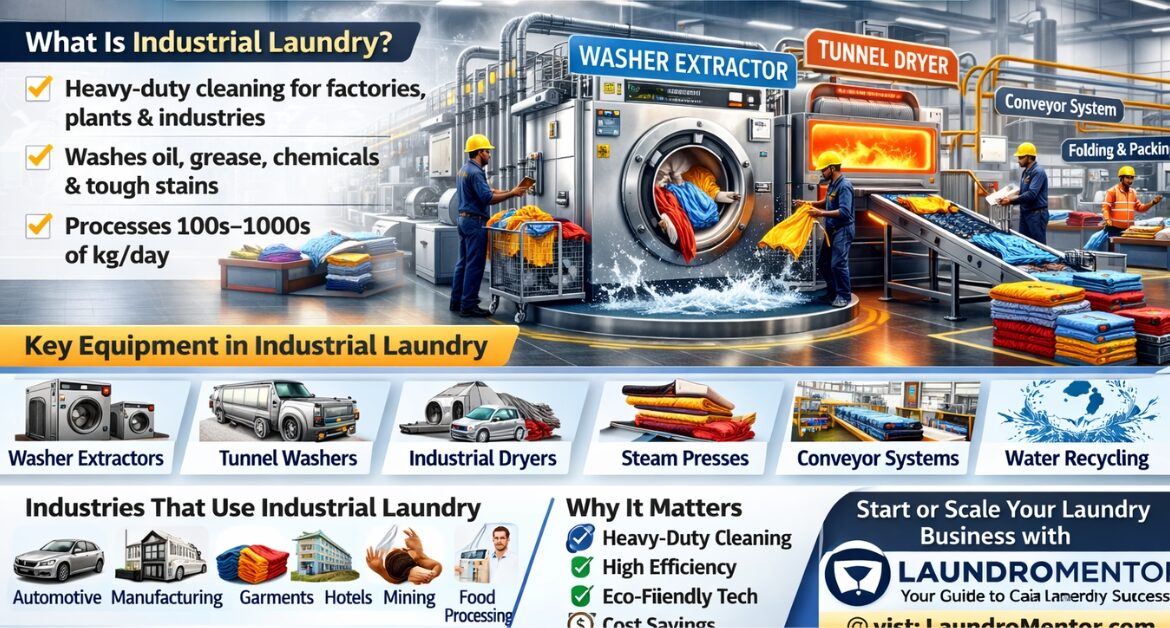
Industrial laundry is used to describe large-scale, heavy-duty laundry operations intended for washing, drying, finishing and processing textiles used in factories, manufacturing plants, garment factories, etc.
Industrial laundry has nothing in common with your towels, sheets, and cotton tees. Industrial laundry involves textiles covered in grease, oil, chemicals, heavy dust and debris. We are talking about waterproof hazmat suits and coats, boiler suits, thick janitor uniforms, and other heavy-duty garments that need to be washed with industrial-strength solutions and machines that can run all day long without issue.
Scale, durability, and specialization are what set industrial laundry apart. Facilities will process multiple hundred kilograms of laundry daily and machines are made to process that amount without failing.
How Industrial Laundry Differs from Commercial Laundry
This is one area that tends to get confused. Commercial laundry normally washes for hotels, restaurants, hospitals, salons – basically any business that has a need for large quantities of clean towels, linens, and uniforms. Industrial laundry is focused on the uniforms and linens from a manufacturing and production facility where the soil is significantly heavier and the production requirements are exponentially greater.
There are differences in fabrics being washed, degrees of stains and soiling, size of loads, and automation. A commercial laundry may be washing hospital bed sheets and patient gowns. An industrial laundry may be washing mechanic uniforms covered in oil, flame resistant work uniforms, and safety gear that has been chemically treated. All of these garments require different wash chemistry, water temperatures, and machinery with heavy duty parts.
The Core Equipment Used in Industrial Laundry Operations
One of the most fascinating aspects of industrial laundry is the machinery. These are not oversized home appliances. They are purpose-built, engineered systems designed for precision, speed, and endurance.
Here are the primary types of equipment found in industrial laundry setups:
- High-Capacity Washer Extractors: These are the workhorses of any industrial laundry. They can handle loads ranging from 50 kg to several hundred kilograms per cycle, using programmable wash cycles tailored to specific fabric types and contamination levels.
- Continuous Batch Washers (Tunnel Washers): Designed for truly massive operations, tunnel washers process laundry in a continuous flow rather than in individual loads. Fabrics move through different washing zones automatically, drastically improving throughput.
- Industrial Tunnel Dryers: Matched with tunnel washers, these dryers handle enormous volumes of fabric in a continuous process, using energy-efficient heat systems to reduce drying time and operational costs.
- Conveyor-Based Material Handling Systems: Automation is central to industrial laundry. Conveyor systems transport soiled and clean laundry between different processing stations, reducing manual handling and improving workflow efficiency.
- Steam Presses and Automated Folding Lines: Finishing is just as important as washing. Steam presses ensure uniforms come out crisp and presentable, while automated folding lines handle large quantities of garments quickly and consistently.
- Water Recycling and Energy Management Systems: Modern industrial laundries incorporate eco-sustainability technologies that recycle water, recover heat, and reduce energy consumption, all of which translate into lower operating costs.
Industries That Rely on Industrial Laundry
Industrial laundry is not limited to one sector. Its applications span a wide range of industries, each with unique requirements:
- Automotive and Manufacturing Plants: Workers in these environments deal with grease, oil, metal dust, and chemical residues on a daily basis. Their protective clothing must be cleaned thoroughly and regularly.
- Garment and Textile Manufacturing: Large-scale garment factories generate significant volumes of fabric waste and workwear that need processing.
- Food Processing Facilities: Hygiene is non-negotiable. Food industry workers require uniforms that are sanitized to strict standards.
- Petrochemical and Mining Industries: Workers handling hazardous materials wear specialized protective garments that need very specific wash procedures.
- Construction and Infrastructure: Heavy-duty work clothing from construction sites requires industrial-grade cleaning to remain functional and safe.
The Role of Automation in Modern Industrial Laundry
Industrial laundry operations have evolved into fully automated systems. Tasks that once took armies of hands can now be done with equipment that sorts, washes, dries, presses, folds, and packages with little human interaction. Industry is automating their processes to achieve more consistent cleaning, save on labor costs, improve turn around time, and meet stricter hygiene standards. Minimizing human contact during the cleaning process eliminates human error which can cause problems when equipment or clothing becomes contaminated. In some industries, not properly cleaning a worker’s protective equipment can cause a safety issue.
Most industrial laundries are equipped with some type of conveyor system for moving materials from one station to the next with no interruption in process. Washer temperatures, chemistry, and drying times can all be pre-programmed into a PLC (programmable logic controller).
Eco-Sustainability in Industrial Laundry
Environmental responsibility is becoming increasingly important across all industries, and industrial laundry is no exception. Modern industrial laundry operations are integrating energy and water-saving technologies that significantly reduce the environmental footprint of high-volume processing.
Water recycling systems capture and treat rinse water for reuse in subsequent wash cycles. Heat recovery systems extract thermal energy from exhaust air and hot water to pre-heat incoming water supplies. Together, these innovations not only reduce the environmental impact but also bring down operational costs, a win for both business owners and the environment.
This dual benefit of eco-sustainability and cost reduction is one of the reasons more industrial facilities are investing in upgrading their laundry infrastructure with modern, efficient equipment.
How LaundroMentor Helps You Navigate Industrial Laundry
If you are researching, planning, launching or improving an industrial laundry operation, then accurate and detailed information could be invaluable. LaundroMentor was designed to fill that need. We’re not a franchise scheme offering you just one way to build a laundry. We offer mentoring and a step-by-step guide for entrepreneurs and business owners who want to build their own laundry how they want it.
Whether you are researching industrial laundries for a factory, a clothing processing plant or simply don’t understand how different laundry equipment and systems work, Laundro Mentor will give you the information you need to make educated decisions about your commercial laundry needs. From selecting heavy-duty washers and dryers to planning automation and eco-sustainability, we’ve got you covered.
Key Factors to Consider When Setting Up an Industrial Laundry
Setting up an industrial laundry operation is a significant investment that requires careful planning. Here are the most important factors to evaluate before getting started:
- Volume Requirements: Estimate the daily kilograms of laundry you need to process. This determines the capacity and type of equipment you need.
- Type of Fabrics and Contamination: Oily uniforms, chemical-treated garments, and standard workwear all require different wash programs and machine configurations.
- Space and Layout Planning: Industrial laundry equipment is large. The facility layout must allow for efficient workflow from soiled intake to clean output.
- Water and Energy Supply: High-capacity machines consume significant water and electricity. Ensure your infrastructure can support the operational demands.
- Automation Level: Determine how much of the process you want to automate based on your labor costs, throughput requirements, and budget.
- Maintenance and Support: Industrial machines require regular maintenance. Partner with equipment suppliers or advisory services that offer ongoing technical support.
The Future of Industrial Laundry
Things are changing in the industrial laundry world. Machines will soon be able to transmit real-time performance metrics to operators through IoT (internet of things) technology. Machine learning and AI will be implemented to perform quality control and catch dirty garments before they leave the wash. And the demand for sustainable operations will see an increased use of waterless and low-water technologies.
The more factories and industrial operations are built around the world, the more there will be a need for dependable, high-volume laundry services. By taking the time to properly plan your industrial laundry operations now and investing in the right equipment, you can set up your business to run smoothly for years to come.
LaundroMentor is here to help you get started. Our training takes the confusion out of the equations and gets you up and running.
Frequently Asked Questions
What types of machines are used in industrial laundry?
Key equipment includes high-capacity washer extractors, tunnel washers, industrial dryers, conveyor handling systems, steam presses, and automated folding lines.
How much laundry can an industrial laundry process per day?
Depending on the setup, industrial laundries can process anywhere from a few hundred kilograms to several tonnes of laundry per day using continuous batch systems.
Is industrial laundry eco-friendly?
Modern industrial laundry operations use water recycling systems, heat recovery technologies, and energy-efficient machines to reduce their environmental impact significantly.
How can LaundroMentor help someone starting an industrial laundry?
LaundroMentor provides a structured, non-franchise guide and support system to help individuals and businesses plan, set up, and optimize their own laundry operations from the ground up.

Aman Sawaran is a leading laundry business consultant who has personally guided over a hundred laundromat owners to success. With years of hands-on experience in the laundry industry, Aman specializes in helping entrepreneurs build and scale profitable laundromats and pick-up & delivery laundry businesses. His step-by-step consulting program covers everything from selecting the ideal distributor and perfect location to securing financing and launching a state-of-the-art laundromat within just 3 to 6 months. Ready to transform your laundry business idea into a thriving venture? Aman can show you how to launch, scale, and maximize your profits with proven strategies and expert guidance.


